Novel Problems

Literary readings have become one of London's most unexpected forms of nightlife. But why would anyone spend a Friday night in a packed nightclub listening to strangers read from their novels? Starting from this question, Will Kaye offers a witty portrait of London's literary scene, where aspiring writers, artists and creative hopefuls gather in clubs, bars and churches to listen to strangers read aloud. Beneath the absurdity of drunken audiences, endless networking and the occasional terrible performance by cultural micro-celebrities, the story examines an unlikely phenomenon in which literature becomes a vehicle for gathering, self-fashioning and participation in a city increasingly hungry for offline forms of cultural life.
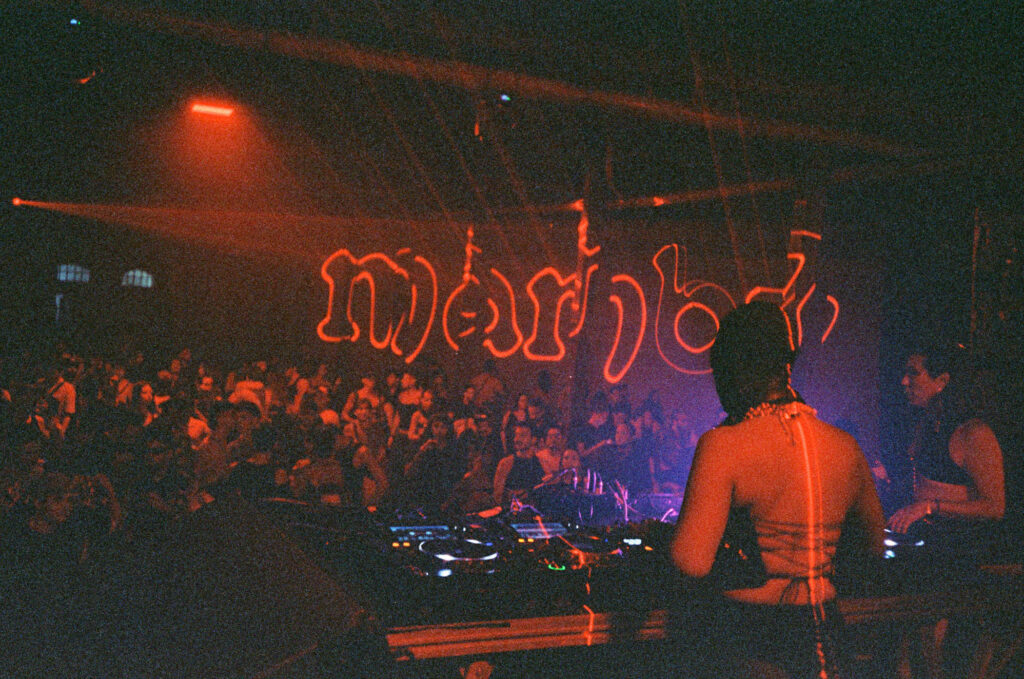
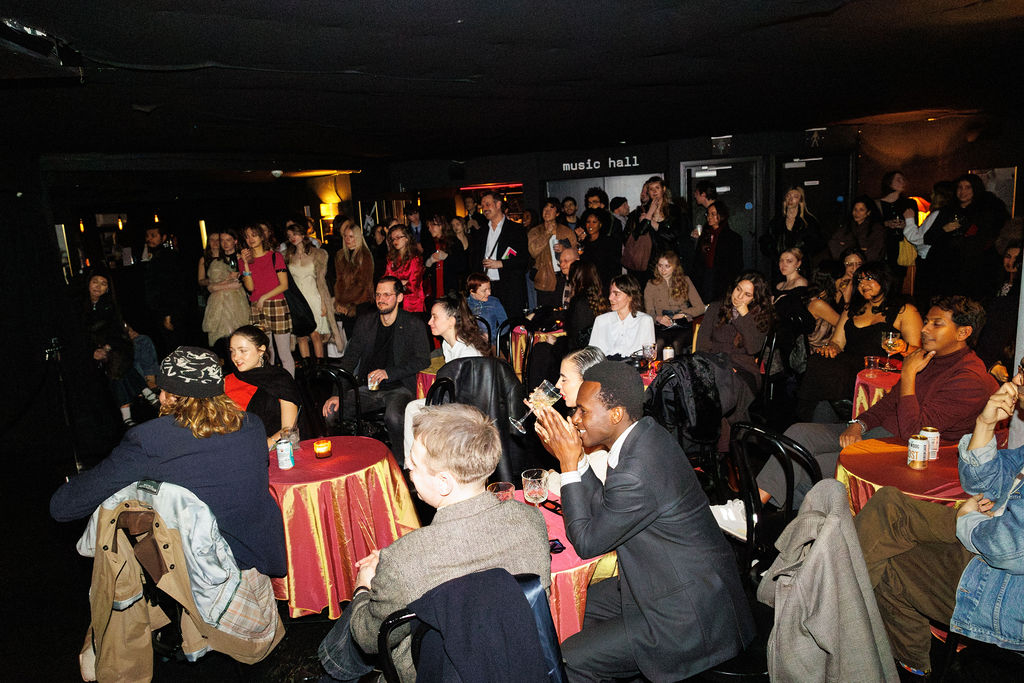
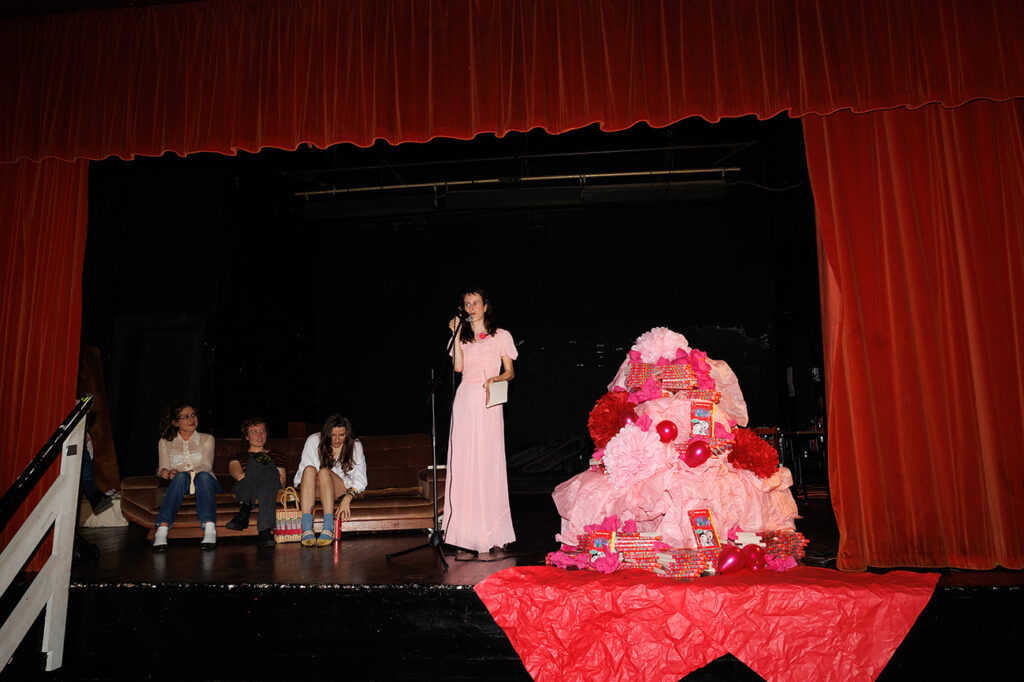
Towards the tail end of last year, I found myself in the packed theatre space of a nauseatingly trendy nightclub, fingers clasped around a 330ml can of lager on which I had spent an eye-watering sum on money, hopelessly separated from my friends, and desperately taking short soldierly glugs of my drink in order to maintain the inebriation needed to continue having a sort-of good time. What was strange was that I was not at the nightclub to listen to music. Nor was I there primarily to get wasted. Instead, I was there to watch six people, mostly in their middle age, read excerpts from their recently published novels. Something strange has happened to Friday nights out in London.
At this point, you would have to be living under monastic rule to be completely oblivious to the ascendency of the so-called London Literary Scene. Almost every British news outlet, from the Financial Times to Tatler, have opined at length about the significance of the readings, lecture nights, and performance events that have, if you were to believe the papers, superseded every other form of cultural recreation in the city, barring perhaps Abba Voyage. It’s hard to deny that a veritable literary renaissance has gripped the city across the previous two years. Poetry readings have transformed from something to be openly mocked and ridiculed to the must-attend events for the young and self-consciously cool. Every weekend, people flock to bars, breweries, restaurants and churches to sit in semi-circles on the floor and listen to amateur prose. Everyone seems to have an ambition to be a writer. I, for example, am being paid to write this very article.
Perusing any kind of editorial on the London literary scene would likely leave the outsider preparing for an orgy full of children, so keen are magazines and newspapers on the idea that this is a specifically Gen-Z trend and it is one whose intellectual output masks a preternatural desire to have bawdy, semi-public sex. In reality, and I am very happy to report this, there are many forty-something men with bald heads, many whacked-out Gen-Xrs who seem inappropriately zonked on ketamine, a rainbow coalition of slowly disintegrating graduate students, a rogues gallery of every distinct type of person who would purchase a tote bag. They gather in Deptford and in Hackney and in Soho and in Islington.
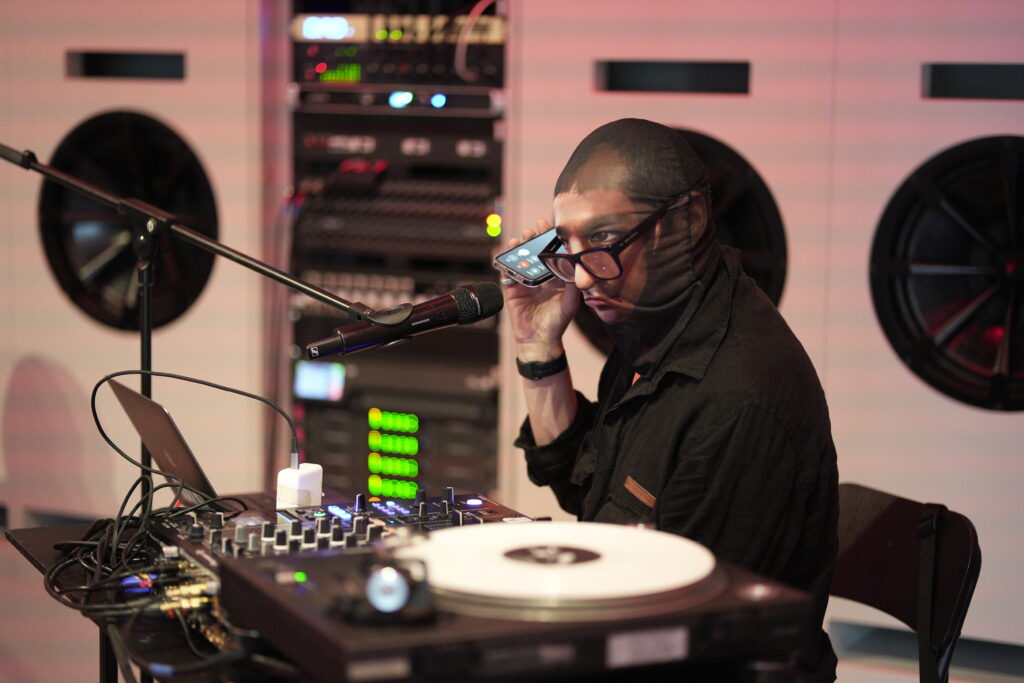
Photos by Amber Pollack.
In many ways, this is not new. London has always been an extraordinarily literary place. It has produced many fine writers, such as Charles Dickens and William Shakespeare. Diagnosing the reason for the explosion of readings and the grandiose popularity of literary culture across the past two years is a tough nut to crack, I think that’s why so many hack writers obsess over the apparent sexiness of it all. In reality it's a complex and non-linear anthropological question. Why are so many people spending their evenings travelling considerable distances to arcane venues in order to to sit down and listen to strangers over-indulge in readings of their own work? Why are these people not drinking 13,000 units of alcohol and doing karaoke, like the generations of yore did?
In reality, and I am very happy to report this, there are many forty-something men with bald heads, many whacked-out Gen-Xrs who seem inappropriately zonked on ketamine, a rainbow coalition of slowly disintegrating graduate students, a rogues gallery of every distinct type of person who would purchase a tote bag.
One thing that’s going on is the peculiar space that readings and other adjacent performance ceremonies offer. For one, the barrier of entry is extremely low, which is good if you are an idle and ambiently creative person who wants to feel like they are contributing to a wider artistic scene without actually doing a great deal. Unlike performing music or stand-up comedy or tap-dancing, there are very few formal constraints to writing something. For example, I am writing this sentence right now. And much like how the ease of access to video production and editing software in our phones means that anyone can cast themselves as a TV presenter, philosopher or film star, the abundance of literary events means that now just about anyone can have a punt at being Martin Amis. Readings are popular for exactly this reason. Suddenly it could be your turn to read from your notes app in the centre of the drum circle.
If I sound cynical, please note that I am an active proprietor of this scourge, having both read at and hosted literary events, and because I am an editor for a London based literary magazine, DIE QUIETER PLEASE. To be clear, most of the participants in this scene are tasteful, well-intentioned and exceptionally erudite. And yet everybody accepts that there is perhaps nothing more nightmarish than a bad reading. Robotic and quotidian observations about sex and relationships masquering under the veneer of autofiction. Poetry about the body, with repetitive references to fruit, eggs and ‘unfurling’. That weird reading voice that people do, where every sentence ends with a high intonation, as if it’s being posed as a question. Horror. Horror. Horror.
I consider the kind of earnest temperament, intellectual curiosity and stoic patience needed to sit through a reading to be Herculean qualities. I struggled to get through many lectures while studying at university without falling asleep, and have often actively disappointed family members by zoning out during dinners of emotional significance. Therefore, that we have started to combine our nights out with activities which require mental diligence seems to me either a sign of a society in radical upswing (which just doesn’t seem very likely) or a social scene which has bitten off more than it can chew. I’m conceited enough to have developed my own strategy for getting through readings, which is to knowingly stroke my chin and nod along when the writer is supposed to be good. When they’re bad, there is very little one can do aside from endure, unspoken etiquette usually preventing one from standing up and leaving, meaning that often I have sat in frozen stasis, daydreaming about which blunt objects you could feasibly sharpen into sharp objects in order to slice open your jugular vein in protest.
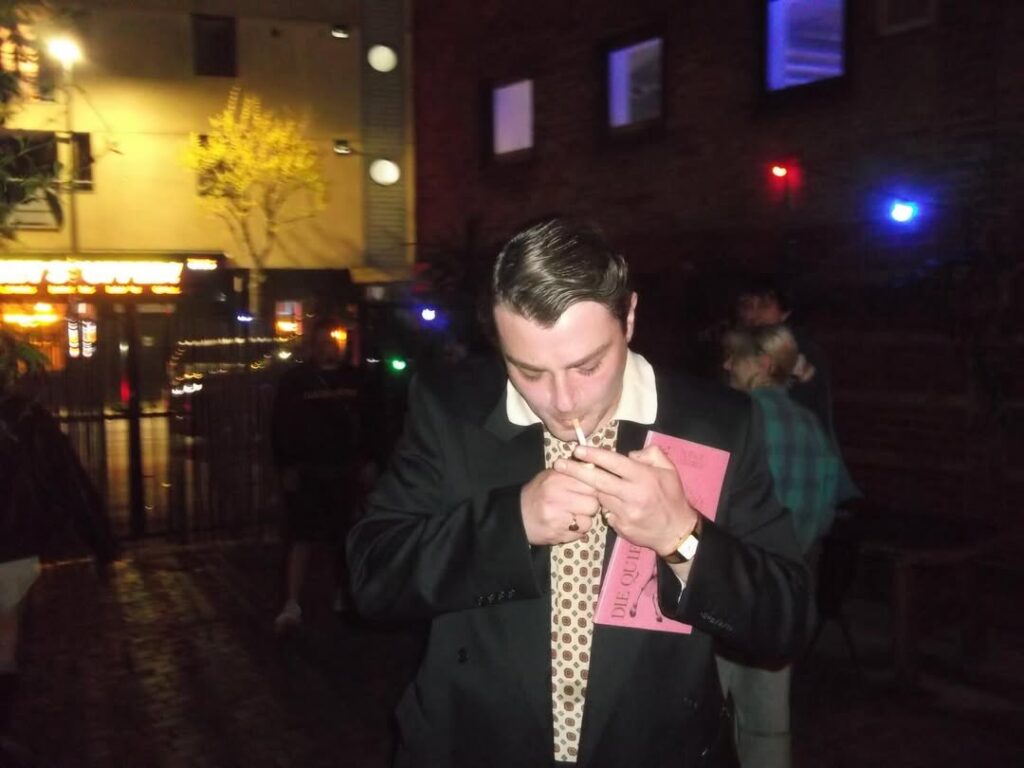
Images courtesy of DIE QUIETER PLEASE.
That weird reading voice that people do, where every sentence ends with a high intonation, as if it’s being posed as a question. Horror. Horror. Horror.
It doesn’t help that most people attend these events inappropriately drunk. And here’s a problem with the form, as opposed to the content. I’d say the minimum amount of drinks that most people have before going anywhere is four. You then inevitably have another two in the mingling hour prior to entertainment commencing. This means that when most readings actually begin, there’s a distracting air of bladders being forcefully constricted within the audience, and an unholy scrum at the urinal during intervals. And often you’re just a bit too pissed to focus on your own thoughts, let alone someone else's musings on sex, relationships, New York City, late-capitalism, or the London rental market. How on earth people take ketamine at these events is entirely beyond me.
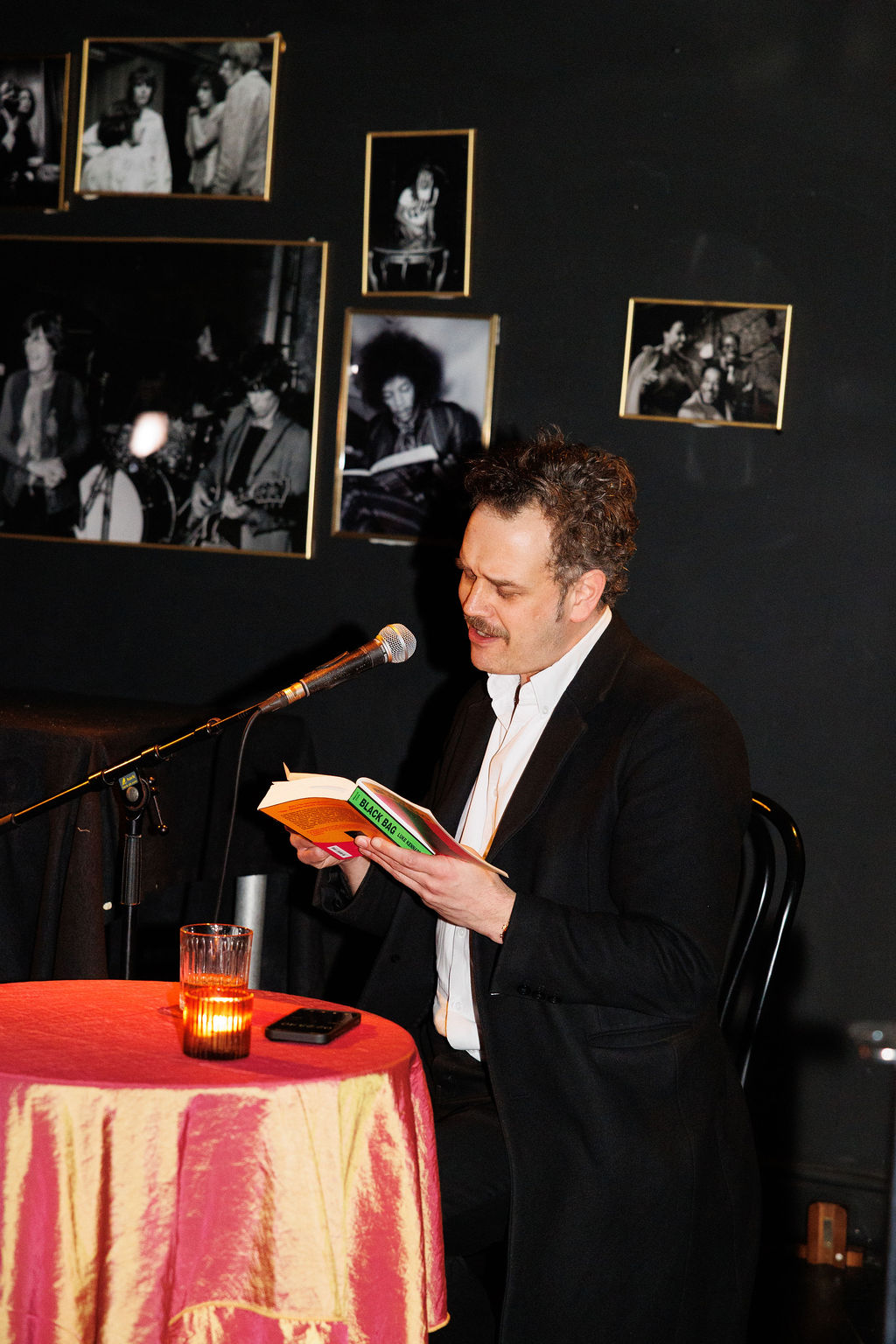
The good readings prioritise exactly the opposite. Strong readers with commanding voices, tackling topics in a razor sharp format, priorising humour or affect. Vanessa Onweumezi reading from her collection Dark Neighbourhood, her voice seemingly built for radio. Or Luke Kennard, speeding through a section of his latest novel Black Bag, with an effervescent comic tone and timing, leaving a room full of onlookers in tears. It’s at moments like this when the barrier for entry comes back into relevance. At the end of the day, if you want to play the bass guitar, you will need to know how to play the bass guitar if you have any hope of impressing your friends. A good reading, or a literary event adjacent to it, shows you that there needs to be much more than words on a page to electrify an audience. Incidentally, if you give me a soapbox and enough to drink, this is probably where some of my slightly less popular opinions start coming out, such as democratisation not being an absolutely good thing.
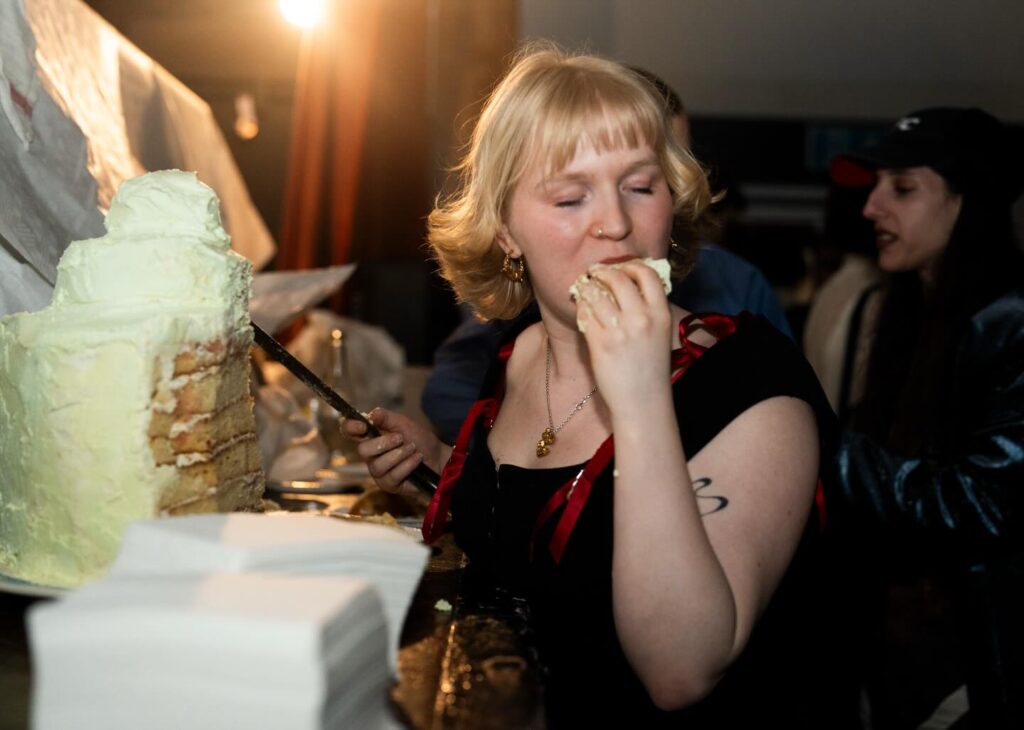
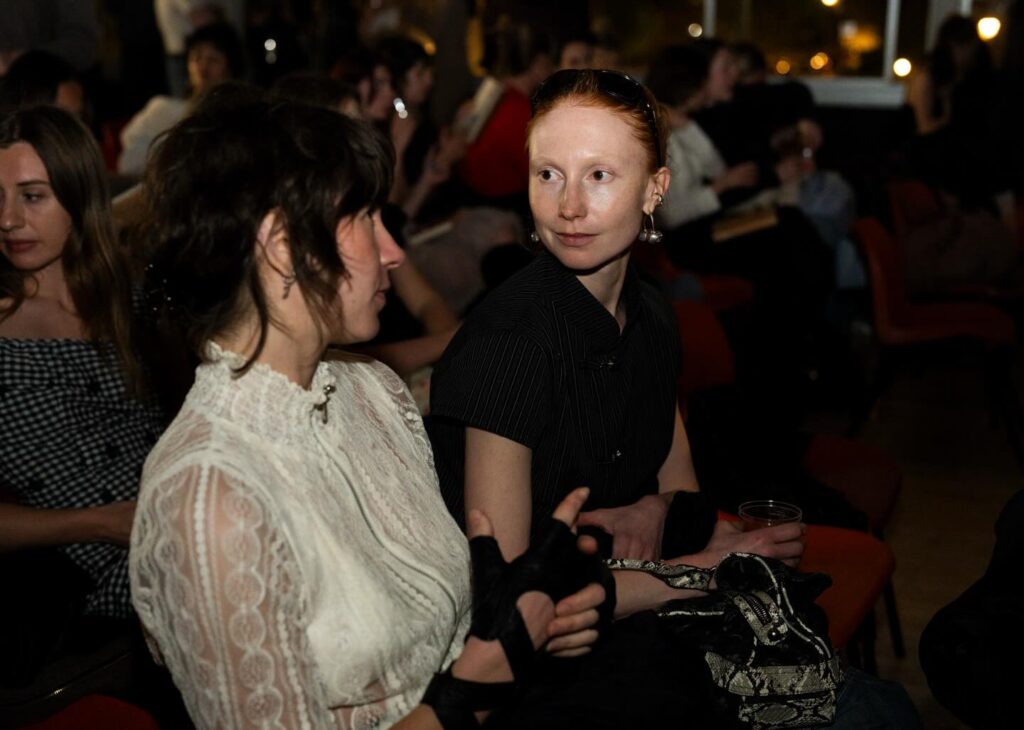
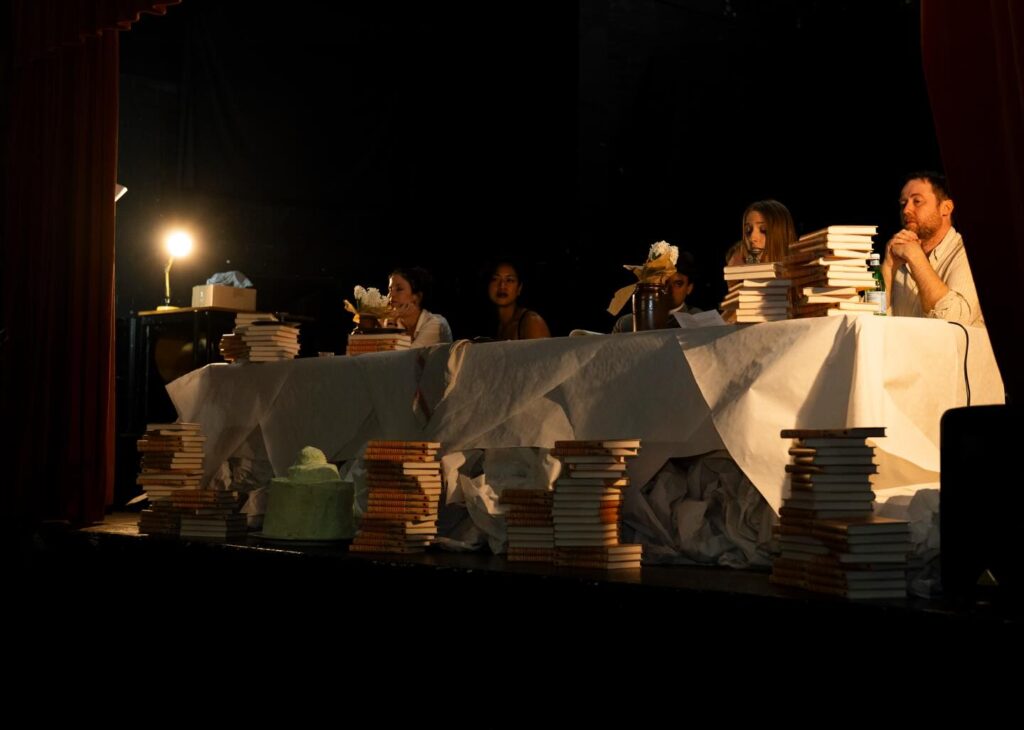
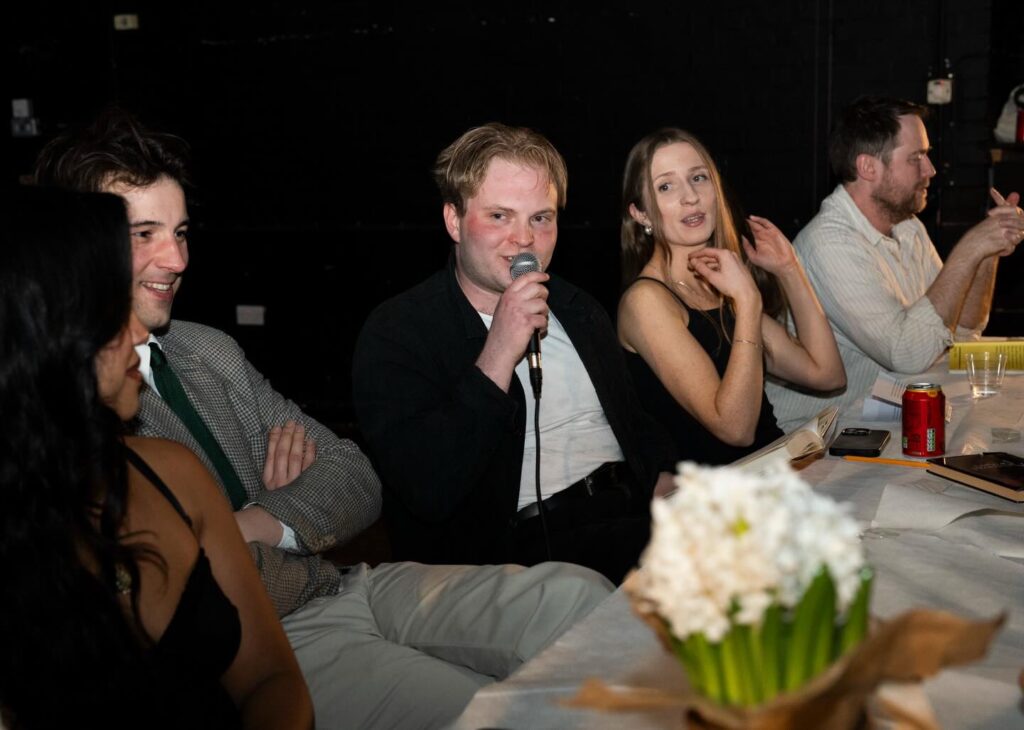
Launch of TO ENTERTAIN by Jago Rackham at Soho Reading Series. Photos by Anya Broido.
Now, the above observations might have been relevant and pithy had they been made 18 months ago. At this point, the notable organisations in the London literary scene have evolved and matured, and quality control seems to be much less of an issue. Soho Reading Series exists exclusively to launch novels of early career writers, Lost Property gives the stage to increasingly notable micro-celebrities. Established magazines like The Fence and the London Magazine discover new audiences. There are a slew of new magazines, like DQP, as well as many others I refuse to name as I do not like giving advantages to my competitors. Talent is being nurtured, and young artists are being given the space to experiment with content and form. Some of the best writers we have platformed we found at London reading events, people like Ben Pester, Yoel Noorali and Gabrielle Sicam.
There’s still a bit of a jamming square peg into a circular hole about all of this. For most, reading is a necessarily private enterprise, so making it public feels bizarre and unnatural. There is a cynical journalistic impulse to claim that these events are actually networking events for ambitious people who want their chance to read their work at the next event, and that this is somehow bad. I would counter that this is entirely true, and that this is actually a good thing. The vast majority of people I know who moved to London moved here because of the indecipherable feeling of opportunity the city promises. That many of these same people are flocking to events that have a seemingly democratised sense of artistic worth, a liberal attitude to the consumption of alcohol, and a reward mechanism for the bold, seems logical.
There’s also the fairly rudimentary factor that people of various ages and sensibilities are unified in their exhaustion of digital media and the evanescence of digital experiences. People are bored of reading shit on their phone. Ironically, they are less bored of watching somebody else read shit on their phone. Who knows how things ended up like that. Life truly does work in mysterious ways.
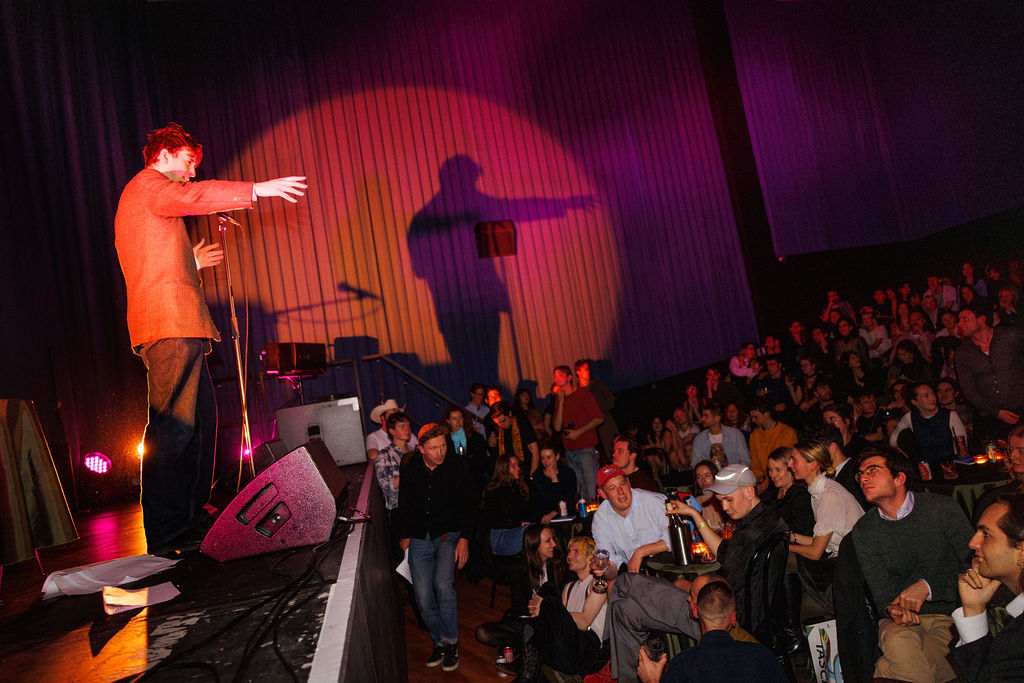
For me, it is encouraging enough that the London literary renaissance has not followed in the footsteps of the so-called Dimes Square movement, which I am told is a sort of evil phantasmagoric step-father to the London scene. I personally have worked very hard to remain willfully oblivious to what ‘Dimes Square’ is. Or where it is. It is unclear to me whether it is an actual place. Anyway, I endeavour to never learn any more about it, and to hopefully never have the misfortune to visit New York City. All I do know is that Dimes Square seems somehow responsible for the global faux-Catholic revival, and that it is unquestionably evil. We sadly do not have the same abundance of malevolent financiers in the London scene, meaning less of its talent is persuaded to publish treatises supporting the destruction of democratic institutions. If any such British financiers do exist and would like to give me money, please feel free to DM me.
Now, there are a lot of obscenely wealthy people in the London artsy fartsty scene, many drug addled nihilists, and lots of people who have probably done very bad things. But that the movement has not descended into Pound worshipping fascism is genuinely a nice thing, and proves that some outcomes very much defy any kind of statistical modelling.
Are we experiencing a literary gold rush in London? It is honestly hard to tell. Many of the city’s older writers have remarked, with incredulity, that until a few years ago, book launches exclusively took place in the LRB bookshop, and were attended solely by podcast mums and ghostly PHD students. Now your average working novelist is forced to do both that and attend evening launches in increasingly inappropriate venues to crowds of intimidatingly dressed models. How they explain all this to their wives and children is another one of life’s great mysteries. C’est la vie. With any luck, in a few years time, everything will return to normal and we will all spend our evenings in karaoke bars again.