Foraging for Boiling Heads in Acid: listening to our surroundings at the beginning of the millennium—David Toop in conversation with Luigi Monteanni
Ambient music isn’t properly a genre, but a way of listening shaped by the instability of contemporary life. In this conversation, David Toop, a leading figure in the study of contemporary music and sound cultures, and Luigi Monteanni revisit the history of ambient, moving from ritual and free improvisation to algorithmic culture, tracing how sound can reconfigure perception and reopen a relation with the world beyond productivity and digital saturation.
I met David Toop for the first time casually at the European premiere of the restored version of The Arrival, the cult 1980 DIY sci-fi by the Unarius Academy of Science, an event I organised as part of Mindwarcinema, a series of screenings at the Horse Hospital I curated with Alex McKenzie and Mark Pilkington of Strange Attractor Press. Even though I have been reading and listening to Toop’s work for years, given Unarius’ ambassadorship for extraterrestrial life, it seemed strangely apt that I would have met him in outer space. Flash-forward two weeks, after an hour of noisy and humid transportation, I reach Toop’s house in north London in the early afternoon grey-and-white London. I greet him again at his door. I haven’t eaten. My belly is only filled with cigarettes and coffee, a magic potion spawning borborygma in my stomach: involuntary intermissions in every discussion we have.
The house is quiet and humble, filled with books and records, but there’s no music on. It seems that anything in this house is thinking, and somehow any book, any drawing, any screen in the room seems to be connected. Or more simply, I got used to connecting things as the magus taught readers to do through his literary work, monuments to the capacity for everything to be everything else and to come out of the pages with the impression that we have encountered something ambiguous and beautiful, a testimony to how Toop is interested in communicating how important this feeling is to his own sense of discovery.
Although I aim to reexamine and discuss with him what kinds of evolutions ambient has undergone as a methodology for listening and a way of being immersed in sound rather than as a genre, I already know that our discussion will force me to dredge the sonic ocean led by the modern equivalent of oracular talk. Since he published his book Ocean of Sound: Aether Talk, Ambient Sound and Imaginary Worlds in 1995, besides releases on the likes of Room40, Subrosa, and Brian Eno’s Obscure Records, Toop has also written six other texts spanning interests in visual art as a form of sound recording, imaginary worlds, digital technologies, and sonic theory.
Meanwhile, over these 31 years, ambient, like any other musical phenomenon, has crossed many thresholds and styles, absorbing and digesting the different and similar. Yet, differently from the past, where musicians, scenes, and subcultural movements could simply disappear in the haze of their own fog machines and burning joints at the city’s threshold at any signal that the enemy may have seized their secret bases, maybe for the first time in history the movement seems stuck in contemplating his own practice, pointing out a symptom rather than addressing it, as they abandon the mirage of a physical space hosting their hallucinations and spiral into folding all servers’ ruins onto themselves. I just want to ask the magus whether this direction they’re pointing toward, this luminous presence they see in the distance, is just some dead star shining for the last time through the atmospheric echoes and delays of this ill-fated universe. I am undoubtedly bound to fail. I try to remain committed to being guided by voices.
L: Thanks for finding the time. I was here to discuss the non-concept of ambient in relation to your interpretation of it in Ocean of Sound and how you think these ideas might have evolved.
D: Let’s move to the window, I think better when I look at my garden. Do you want some tea? I was going to make some.
L: Yes, please.
D: It strikes me that people still want to talk about Ocean of Sound. It was a long time ago, 1995. So in a way, I am pleased about that. It’s nice to have a book that lives beyond a year or something, but it’s also strange. I am not that person anymore. The nature of the times now is so different from that moment. I sometimes think, why can’t I write another book like Ocean of Sound? My writing is, in my opinion, of the same standards, and I still have lots of ideas, but it’s not just you as a writer; it’s also the times you live in that give you the subject. And that moment was a perfect time for that subject for various reasons: an awareness of the environmental crisis was really building. It was the beginning of the internet and the information revolution, and you’d never know where it was going, but there was a sense of it for those who were paying attention. There was a sense that everything would change, and lots of technological development at that time. Which was positive and utopian, but of course it never is. So half of you want to believe that it is utopian, but the other half, if you’re a sceptic like me, is saying: we’ll see.
L: Well, my impression of Ocean of Sound is not exactly that it is a utopianist book.
D: Yes, it’s partly about utopia, but it wasn’t utopianist. I think that I foresaw or predicted that the idea of this whole genre, if you like, would become a kind of aid to productivity. And that’s exactly what happened. The last few pages, that’s what I was writing about. And the way that it would kind of absolutely drain the blood out of the sources that were at the origin of this whole movement. To some degree, I saw the origins of this music as being shamanistic and thus partly about crisis. Crisis on both sides, of the shamanistic figure and of the need for such a figure in any community. Someone having a healing function, or however you want to see it. Psychoanalytically or whatever. It’s a necessary healing function. But it means confronting a crisis rather than burying yourself in some kind of digital utopia. This is what I was imagining and foreseeing. All of that has, of course, happened, so it’s strange to look back at it now.
L: But isn’t it perhaps for the reasons you are underlining that it’s still a relevant book?
D: I don’t know why it’s a relevant book. A lot of the music I wrote about is from a long time ago. I am not sure what that says. Some of it has completely disappeared. Some of it existed as a critical and important moment in the development of certain kinds of music, like acid house and the evolution of techno. Or just this idea of ambient music. So, that was about formative moments. But the actual history of how this ambient music movement came about is kind of an old story now. But a lot of the other materials that are contextualising and really trying to rethink the history of the 20th-century avant-garde. I guess that has become increasingly relevant because new generations keep coming and remain curious.
L: It’s interesting how many people underline the anecdotal nature of the book, but when I read it, my impression is that the same ideas ricochet through different kinds of scenes and phenomena. It’s not necessarily a convoluted and obscure book. I think that it’s Simon Reynolds who described it as a luminescent reading because it lets these ideas shine through the pages.
D: I really struggled to find a form for the book. I wrote the beginning of it after thinking about it for some years. I wrote these passages about listening, and then for months, I couldn’t write anything. I did not know what to do. I thought, I know these things because I am a musician. Also, this comes from my years as a music critic. And interviewing all of these musicians, there was a sense of equality. So, there’s a sense of an understanding that maybe other people don’t have. But I also realised that there was a personal aspect. That I did not have to write in a conventional narrative form. Chronologically, for example. I could write in a modular way. That partly came from technological development, like computers’ cut and paste.
L: Derrida was especially fond of that. When he discovered Ctrl+C and Ctrl+V, he went crazy being able to redo the language.
D: Yeah! And hypertext. All of the excitement of that time was about hypertext. I mean, now it’s a pain in the arse, but then it was very exciting because it suggested new ways of writing, and I mean, all writing is new writing, everything from Burroughs to Joyce, the sound and concrete poets, I was very familiar with all of that material, so it was interesting to pursue it through this technological function. I realised that if I wrote in that modular way, I could jump from one thing to the next. The connections were in my mind, and I did not have to underline those connections. I could let people make them for themselves. You know, listening to records and finding their own way through. And that makes a book absorbing, because it gives you credit for intelligence and also makes the book a little bit of a puzzle. How does this paragraph about Egyptian coffin text relate to Marshall Jefferson?. Let’s follow it through.
You know, it’s cliché that you cannot turn your ears off. You do it all the time. I am here talking to you now, I am not hearing what I could hear if I were looking out of the garden on my own here.
L: To me, it’s interesting because these ideas parallel the capacity of listening. Many people still believe it, just like reading, to be a passive activity, a passive sense. Yet, if you look into the academic traditions, Pauline Oliveros’ quantum listening or Steven Feld’s acoustemology, we discover that listening is actually an active way of sounding.
D: Yes, it’s an active way of foraging. That’s the way I see it. People think of sound as this dynamic force that approaches and invades you. But to me, you’re moving out into the world, and you’re finding… You know, it’s cliché that you cannot turn your ears off. You do it all the time. I am here talking to you now, I am not hearing what I could hear if I were looking out of the garden on my own here. My ears are now not foraging out there, not searching for sound. You could argue that sound is a passive element because it’s waiting to be discovered. I was reading yesterday Peter Sloterdijk’s Bubbles, and he talks about the ways an unborn baby has to switch off from all the noise of their mother’s digestive system, this chaotic industrial noise inside the body. So the unborn baby has to be able to switch off, otherwise it comes outside into the world completely shocked with sound.
L: Yes, in relation to that, there is this cliché in sound studies that we don’t have earlids. But then in the same book, the same page, the original author of this idea [Jonathan Rée cited in Rorschach Audio] defuses his own theory by saying that even if we don’t have earlids we can cover our ears with our hands, and actually even when we close our eyes, which is usually used as a comparison thanks to the supposed human ability to shut down the field of vision, the eyelids allow for information like light to pass.
D: Yeah, it’s a theory I used to hear a lot. I am currently working on a new book where I wrote about that last night. There is this interesting idea of why we rarely hear sound in dreams. You hear sounds occasionally in dreams, but it’s not very common. And part of the reason might be that we are conscious of sound, but not enough to wake us. So we are not able to hear it in the conventional sense. Of course, if you hear a siren or a car alarm, you’d wake up because it would overload the system.
L: How could we conceive of ambient? More than a genre, it’s a mode of listening and an aesthetic universe around which people have floated, making new meanings and discovering new things.
D: Well, ambient is a problematic word. It’s very flexible. You could talk about ambient temperature, even. But in general, it means surroundings. And that’s at the heart of one of the most difficult aspects of thinking about an idea of environment, because it’s always outside of us. No matter what we do to try and think of ourselves differently, as not a fixed entity, not a bounded, separated entity, but something that is in flux and flying through. So these words kind of defeat us all the time. Ambient is the same as environment in a sense. Puts us inside something and separates us from something. And so, it’s impossible to think of ourselves as being a part of rather than distinct from certain meanings. I mean, I don’t know what to do with this problem. But the book was important to me for a number of reasons, and this was that it put me more towards an idea of listening rather than working with sound or making sound or being obsessed with sound. Listening to me is much more productive and much more applicable to the problems of our lives. Because if we’re making sound, we’re projecting out from this bounded entity.
L: The old boundary problem.
D: Yeah, the boundary problem (laughs). We’re projecting out into the environment. We’re making an ambience. But if we’re listening, we’re much more in flux, much more open. In a way, we’re much more curious and have a greater empathy with all other entities and objects and beings and materials and so on. But I mean, all these words are difficult. I was re-reading Jane Bennett’s book, Vibrant Matter. She is talking about objects and said that the word material is problematic because it suggests something that’s fixed, and it never is. So that move towards listening was crucial.
L: Is it worth it to differentiate between ambient and ambience? They seem to go hand in hand.
D: They are kind of thin words, really. I am not even sure what ambience is supposed to mean. I made the point in Ocean of Sound that it means surrounding, and to talk about ambient music is this disastrous narrowing of its possible meanings. It just means a kind of style, then, and what I was trying to do in Ocean of Sound was to push this idea of the style until it broke the membrane. It did not have those boundaries anymore. And I remember that because the ambience, if you like (laugh), during which that phase of ambient music grew, it was a sort of rediscovery of a hippy moment, but I was old enough to have lived through that hippy moment as a teenager, so I wasn’t really particularly inclined to get involved at that level, but there was a lot of neo-hippy techno stuff at that time, which meant that a lot of the music was very trippy, so when I put together the Ocean of Sound compilation, I included things people were horrified by like Peter Brotzmann. To me, that’s an ambient track. It completely immerses you in sound. And I remember doing a radio interview about the compilation, it was a five o’clock show in the afternoon, and the DJ told me, "Much of the music on the compilation is great, but that Peter Brotzmann track is horrible. It is like boiling your head in acid. I said, well, that’s kind of ambient in itself, boiling head in acid, not just this narrow idea of kind of hippy nostalgia. And you still come across that a lot. Especially among younger people who are interested in ambient as healing music, or as a kind of enlightenment, and that’s so cliché, so I have no interest in that.
It is a term that came to be used to express something, maybe wrongly, but it expressed something. And the idea is that this music expressed a need. Most of the music does not actually meet that need. It creates a kind of false manifestation of that need.
L: What I find interesting is that, in relation to ambient, these words are not necessarily useful to anyone; rather, they are useful towards finding new misunderstandings, so to speak. I wonder why people keep on using these words even if they are not entirely happy to use them. During the early 2010s, we had a number of projects that seemed to defy what ambient seemed to remind people of. I’m thinking of Sam Kidel’s call centre ambient in Dizruptive Muzak, or Dedekind Cut’s and Chino Amobi’s works on a label like NON, and even Vaporwave seemed to kind of join the genre’s horizon. Additionally, you would find journalists writing about the death of ambient, yet this word survived.
D: It certainly addresses a need. Thus, it requires a name. But you could say the same of impressionism. It addressed a need to define a way of seeing that was changing. The idea of hard-line and very defined masses was disintegrating into a flow of light, and almost the dissolution of the solid object, so people called it impressionism. But artists did not want to call it that. And now it’s a major movement. So it’s impossible to lose it as a term. And it’s the same with ambient. It is a term that came to be used to express something, maybe wrongly, but it expressed something. And the idea is that this music expressed a need. Most of the music does not actually meet that need. It creates a kind of false manifestation of that need.
L: And the need you would say is still this opening to the surroundings and immersing yourself in sound?
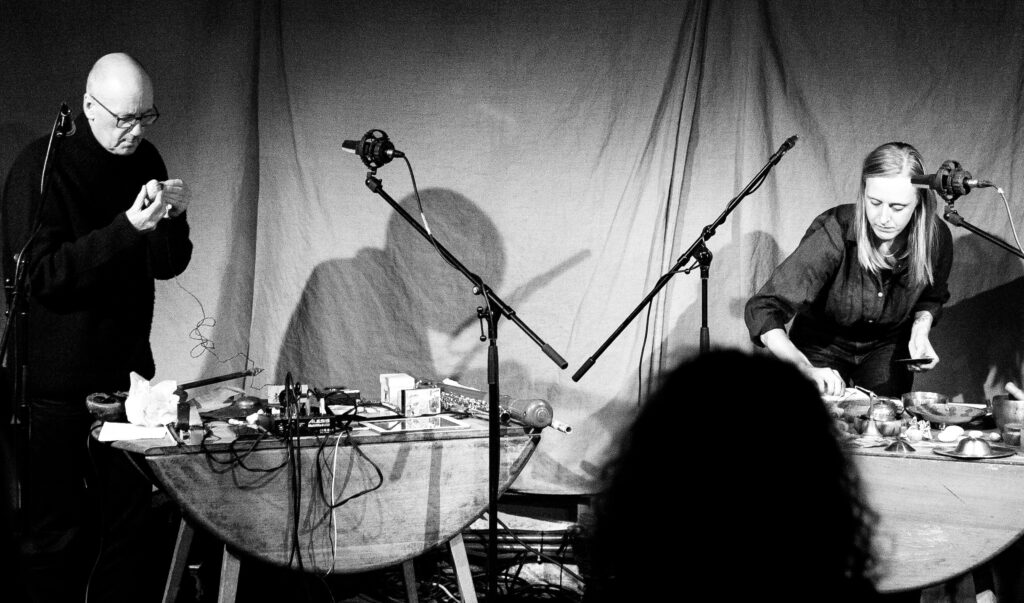
D: Well, I’m interested in the idea of entering a space and articulating space through sound and movement. My main interest now is the duo I have with my wife, Ania. More Skin Sound, which is really about entering a space and leaving a space. What happens when you enter a space? That’s why I work completely acoustically now and without any traditional instruments and avoid amplification as much as I can. It’s a kind of radical step, because if you think of amplification, now it is assumed to be a kind of baseline from which everybody starts. Everything comes out of loudspeakers. And that’s interesting. I still use the computer, loudspeakers and amplification of various kinds in my music, and I would not say that I’m a Luddite, because that’s about people trying to keep their job; it’s a very specific word that you can’t use in a vague way. But you probably understand what I’m saying. We are trying to examine something from a very particular point of view.
L: But isn’t it interesting that a lot of these ambient experiments were about manifesting things? As opposed to Oliveros asking people to be receptive and multilayered listening, people playing this kind of music also pursued activations and transformations of place. And if I link it to your book, to your explorations of caves as acoustic environments where echoes are able to reformulate and send back these transforming sounds, how do you see this relationship, this tension musicians have developed between manifesting an environment and, at the same time, being receptive to the outside?
D: I think it has to do with their relationship to silence. This has been so important in the whole discourse and development of music in the 20th and 21st centuries. The question of whether there’s any need to do anything, and why we choose to do anything and why every time we decide to do anything, it’s so problematic. How you make sense of that is a very particular and personal decision. I have been through periods of my life where I have tried not to do anything. Being unable to listen. And I recognise that I have a kind of drive inside myself I can’t do anything about. If I were a religious person, I’d say something like, I was brought to earth for this thing.
L: An eschatology!
D: Yes, correct, and then I’d have a responsibility to do it. I don’t think in that way, but there’s some truth in that. If you have a certain capacity, you have to follow through because god knows there are enough benevolent forces coming back, which are basically turned to destroy these ideas. There’s a kind of compulsion to continue to work, and I’ve been through periods recently where I have been completely unable to work. Your motivation changes and your energy changes as you get older, and you have less demand from people to do things, so it’s easy to just end up doing nothing. And then you kind of fight through that, and you’re back to the same obsessions and need to continue with these ideas you’re working with. But it really makes you question, why am I doing this, and why is this so important?
L: Going back to places that are far in time or geographical location, I like this idea that I think is present in Ocean of Sound, of ambient as a kind of elsewhere. As something that can be traced back to Debussy and his encounter with gamelan, do you think that we can trace its theorisation as the encounter with something other? In the case of Debussy, the manifestation of the reverberations and echoes of another place. This would be compliant with his reveries, fantasy tropes and orientalism as well, while explaining why it was so important for an instrument like gamelan to have arrived from elsewhere. But this elsewhere survives in Telepathic Fish and even Sun Ra dreaming of space. An extreme elsewhere that also artists like John Hassell have shared through their mixing of dream scenarios and mythical locations.
D: Well, yes, I think it was a very utopian movement. I mean, I also wrote a book on exotica, and that’s something I return to again and again. My latest book, Two-Headed Doctor, was applying those ideas to one very specific record, which at first you would not think of as an exotica record, but has tendencies in that direction. I think that one important aspect of Ocean of Sound for me was the opportunity it gave me to write about many things that were not immediately obvious as ambient music, like Sun Ra, for example. Sun Ra is one of the clearest examples of someone thinking about a vast elsewhere in order to deal with the constraints, brutality, and limitations of life on Earth. And of course, there are Sun Ra tracks that would fit into a kind of ambient mix, but that’s not the point. He was creating them for himself, and his musicians were his followers. A world of the imagination that had critical things to say about our reality. It depends, of course, on what you mean by ambient, but I think that in a sense all music brings us to an elsewhere. It gives shape to something inarticulate for which we have no words. But we need to dwell that kind of formlessness, and be in a world which partially is meaningless, in which we are carried along by things like rhythmic pulsation, harmonic movement or cohering sounds, or even an understanding of the relational aspects of certain kinds of music where you can tell that everything is related to everything else, and feel a oneness wether is a simple song or something highly complex, this is a human constant, a need every culture has. And some music brings us elsewhere very consciously and deliberately. Music is the most potent medium for doing that.
L: Which brings us back to these healing, therapeutic and shamanistic uses of music. If we examine literal, proper traditions of shamanistic music, for instance, these actors usually have a set goal: healing someone or restoring the balance of the community. They are oriented by a protocol to obtain certain results. But with musicians, this function seems to be brought by moving in the opposite way. They don’t search for anything in particular outside of their own obsession, so what about these new and kind of peripheral approaches to being a shaman?
D: It’s very difficult. I started studying this at the beginning of my twenties, so it’s something that I have been studying for the past sixty years. At the beginning of these studies, I was thinking about the role of music in our society, which had a clear entertainment function. And it did not matter how avant-garde or extreme it got, it still seemed to be in this entertainment environment, and everything was structured to reinforce that entertainment aspect of the activity. I was not interested in that. I can’t remember how I came across the idea of shamanism. But I know that I bought Mircea Eliade’s book when I was 22 [Shamanism: Archaic Techniques of Ecstasy nda] and I found a wealth of useful things, although none of them was particularly comfortable. It sounded like that existed at the extreme limits of human experience. This focus on crisis, liminality. But it helped me to think about this problem, how music was understood. Yet in my time, if you were making music that was not entertaining, you were misunderstanding the point (laughs). And you could argue that the entirety of the 20th-century avant-garde was trying to upset the formats in which music was heard, as entertainment, and it consistently failed. It’s a powerful thing you’re working against. I mean, the whole shamanistic thing has become a kind of travesty. People are going on shamanistic retreats and getting a certificate at the end of it. The theories they have about why drumming works. It has nothing to do with my understanding of it as a practice.
L: But then does this not mean we all need healing? From people with certificates, of course.
(both laugh)
D: That’s right! But I mean, everything is bought from a shop, and I have this thing about it. You know, most of what I play as a musician now is cardboard, leaves, or pieces of paper, or flutes I make myself. You know, even electronic things I made myself. But it seems you can go to a shop and buy these kinds of standard items; you strike one of them, and that heals you. I mean, yes, we all need healing, but I don’t believe it.
L: But if we think of the history of ambient, from Debussy being able to witness a gamelan thanks to colonisation, Kankyo Ongaku and Muji commissioning Harumi Hosono with music for their shops, Telepathic Fish with Thatcherite Britain, there seems to be this continuous tension with capitalism, even at its moments of remediation. I mean, Midori Takada has resurfaced thanks to the YouTube algorithm, and the most fascinating thing is that despite Japanese ambient being pushed by an algocapitalist machine after it was spawned in Japanese rapacious techno-optimism, it is striking to see so many comments saying that this music is healing and the opposite of the modern capitalist world; that it creates community, even. It’s interesting to think about these capitalist remediations and remediations through capitalism.
D: Absolutely. The music that is consistent in my adult life is free improvisation because that’s the furthest you get from hypercapitalisation, because it has never fully been accepted. Nobody’s ever found a way to monetise it. And even now, it’s a lot more popular than when we started in 1969. Yet it’s still marginal.
There's music that can actually facilitate a way of working together without leading to a diminishment of your sense of yourself. In a way, you can give up yourself while you retain yourself. It’s an interesting contradiction that I have seen happen often.
L: The ultimate underground genre.
D: Exactly. You can argue that it establishes and enforces community. The way that we find a mutually intelligible language, even if we’re all different. But the advantages of that are enormous. We live in such divided and divisive times. We’re constantly hearing about fragmentation in politics and social life. The collapse of communities. But there's music that can actually facilitate a way of working together without leading to a diminishment of your sense of yourself. In a way, you can give up yourself while you retain yourself. It’s an interesting contradiction that I have seen happen often.
L: One question in relation to these discussions is the one of repurposing. When it comes to technology and remixing, it seems to me that since Telepathic Fish, ambient’s relationship with patchworking the detritus of history is more prominent, from blooming in the failure of social housing and affordable rent, to reappropriating various sounds, to how the mid-period of recent ambient and its death was recodifying corporate sonic ambiences to how today’s ambient rave scene seems to be thriving especially in appropriation of society’s digital leftovers. How do you relate to this repurposing?
D: I am very interested in foraging. Doing workshops with my wife, Ania. We get people to forage for objects. If you want to build an instrument you did not buy for a shop, foraging makes you think about your relationship to things. Lots of the things I use come from my garden. It has personal meaning for me and connects a number of different states of being. One of which is working in the garden, and another one of which is sitting here. But also, when plants die, then you can use them. That’s interesting. It’s repurposing, yes, but it’s more like composting. It’s following a cycle or implanting yourself within that circle. So composting has become part of the discourse in recent years.
L: Speaking of gardens, something I find particularly interesting is late-1990s ambient’s ability to dream simultaneously of space, technology, and cyberspace, while also celebrating the pastoral qualities of the countryside, as in the work of The KLF or The Orb’s early mashups and plunderphonics. A friend once described Aphex Twin as “the countryside dreaming of space.” These seem to be the only two universes stressed clearly in these productions. Right? “Ambient house was made by sheep,” and all. Is this part of the necessity of not participating in anything?
D: Yes, but it’s a fantasy, isn’t it? The painter Patrick Heron lives in Cornwall, on the cliffs. But the air force used to fly jets over his house, very low. So, this binary between the countryside and the metropolis does not exist anymore. If you went back a hundred years, you could find people in rural communities who had never been further than the nearest village. They had a distinctive accent and dialects; their worldview was very small. Then you had people in cities who went to the countryside as a major adventure. If you consider the birth of tourism in the 19th century, those people were tourists in places like the Lake District. Then they were like pioneers going to the jungle. The first tourists. Professional men who had some time on their hands and wanted some adventure. Now the world has been redefined by tourism. You know the story of this cruise ship?
L: The Hantavirus!
D: Yes. People are going to these places with very specific rats, then getting this virus on one of these monstrous ships, taking it around the world with them. It’s an incredible story. We’re back again to this idea of zoonotic transmission. We thought it was done and we were very stupid, because it’s obvious that there’s gonna be more and more. But, basically, now there’s nowhere that is not inundated by tourists. Even with this idea of agriculture, you can go to the countryside, and it’s very noisy because of agriculture.
L: Yes, Owen Coggins has actually underlined how the countryside is the perfect industrial territory. But then again on the disappearance of those binaries and spaces to dream about in relation to ambient, the ArX label has reissued Pressure of Speech’s 1996 album Our Common Past, Our Common Future, In which the London-based trio, quoting from the album liner notes, “convey throughout the record a profound sense of discomfort and disillusionment, oscillating between utopian longing and a new form of “dystopian consciousness.” A layer of subtle paranoia and imminent collapse infuses the work and can be perceived quite clearly through the negative space of its 1990s techno and breakbeat rhythms, bearing a strong resonance, as the title itself suggests, with the psychic landscape we now inhabit.” It seems that by 1996, even the illusion of the countryside had disappeared. It’s interesting how music becomes something that we try to use to cure ourselves, but also to point out the symptoms of our “illnesses.” It does not feel like an escapist desire, but more the recognition of the fact that radical acts like Fugazi are not possible anymore. So I feel that all these projects use music to ask what it is like to move in a scene of extreme constraint.
D: I do empathise with these notes. Ocean of Sound was released in ‘95. There’s something similar in the sense of being very sceptical and constantly keeping a distance while at the same time searching for some kind of bliss. Searching for that thing that music can do, which is to make us feel like whole beings. I couldn’t have written about ambient in that way if I had not found some of it very satisfying, being involved in it. My first record was on Eno’s label, so what does that tell us? There was a connection there, of course. But I don’t know. Ania and I were in Japan last year, and one of the places we visited was the Kunisaki peninsula in Kyushu. It’s quite near Nagasaki, and it’s a very extraordinary area, very depopulated. Many shrines but not many people. Everybody’s left, which is very typical of certain parts of Japan. So you have these mega cities. Tokyo is a continuous city until you get to Yokohama. But then you have these areas where everybody’s left. There is some farming there, but it’s a bit the same as the depressed area in this country, where you have artists moving to these depressed coastal towns. So there was a small community of musicians there, and the guy who organised the tour for us was living in what had been the place where the teacher lived. But there were no kids anymore, so she was living very cheaply. Kyushu is a place of forests, so there was a lot of tree worship going on. There were a lot of interesting theories about ecology, fungi and trees. But also some quite mystical stuff. And you find those Shinto shrines with a strong connection to natural spring. It was not presented in a kind of new-age identity, but as part of people’s lives. We stayed at this Buddhist temple near Nagasaki, and the priest was this eccentric character having a kind of neo-hippy event at the temple, with an extraordinary mix of people, Japanese hippy types, but also very devout Buddhist older people. And this priest came, a very larger-than-life character. I was a bit confused about his temple. And he explained how some temples are high religious temples, and some temples are for the community. His temple was for the community. He was really interested in being a focal point for the community because he thought the Japanese community was fragmented and needed something to bring people together. And I suppose a lot of these people were into ambient music with trippy visuals, nothing you’ve never seen a thousand times before, but there was something very sincere and open-minded about it. People are very into hip hop, techno, free improvisation, and exotica. It was interesting to see how these very real people tried to work out problems, fragmented communities. I am reading this book at the moment, The Catalpa Bow, about shamanism in Japan. Monks on the Yamabushi mountains are standing in the freezing cold waterfalls. It’s interesting because her research was done in the early 1960s, and she’s seen the changes. There’s one mountain she talks about, in which everyone is going up this mountain, these spirit mediums. All in trance. She went two years later, and the municipality had built a road to the mountain that had destroyed everything in 1962/3. Everyone was going up in coaches, and the main path was overgrown. No one was in trance, everyone was going there as a tourist. Yes, for some healing function, but the mechanism by which healing could take place, these trance rituals, had disappeared.
I am looking at technologies that have been hidden or socially disruptive that have had some occult purposes.
L: Of course, the point of such practices is not the goal but the process by which you arrive there. But, to move towards an end to this interview, I was reflecting on two sentences you have quoted in Ocean of Sound, in the chapter on Debussy. The first is when you talk about ambient as music that leads the listener into a shifting zone, which Peter Lamborn Wilson has described as the "sacred drift," a mode of imaginal travel, "in which the landscape will once again be invested with meaning, or rather with a liberatory aesthetics." The second is the quote of Huizinga, when he refers to music as something that “does not create a song for our ears" but "It is a 'state', such as moonlight poured over the fields." I liked the tension of these two excerpts, because the first one is a disruption to go somewhere, while the second sees music as a state illuminating an area.
D: It’s funny to hear these things back. I have been looking at Ocean of Sound because I’m writing a new book called Instruments of Darkness. The expression comes from Claude Levi-Strauss, from his trilogy on mythology and specifically from “From money to ashes.” And he talks about these disruptive, percussive sounds that come up in myths he was using. But it actually comes from Shakespeare’s Macbeth. The three witches are called the instruments of darkness. So I am looking at technologies that have been hidden or socially disruptive that have had some occult purposes, and there’s a certain amount of this in Ocean of Sound. It’s formally a different kind of book, making connections, so I’ve been sampling my own writing for this new one, you could say. But it’s interesting looking at the book and finding certain references that are really strange to me. Wilson was really popular in the nineties, but not a huge interest of mine. I think it came out of a conversation with Bill Laswell, who at the time was really into these California-types, but seeing this now as a reference, I’m now like, why did I choose that?
L: Yes, but I feel that this sacred drift really fits.
D: Yes, and it captures something of the atmosphere of the music of that time. I have made a record called Buried Dreams with Max Easley, which we made in the early nineties, and no one would put it out until 1994. It got a lot of attention, but some people thought it was frightening. People like Matt Black say it’s not a very ambient record because it’s a little scary. But it was really drifting through different zones. But it was an ambient record, because it had been involved with all the interests that Max and Ix had. Sound sculptures, free improvisation, instrument making, programmed electronic music, but it definitely had this feeling of sacred drift.
L: I wonder if improvisation and sound research are ways to illuminate geographies, metaphorical or otherwise, that you would not know otherwise. This idea of a drift brings you to somewhere completely unexplored. A territory beyond these definitions.
D: Yes, there’s a book I am reading called the “Classic of the Mountains and Seas”.
L: Of course! The Chinese folklore classic. Did you know that this book is now used to describe brainrot in China, algorithmically-generated funny content? I mean, the way this book has been used to describe these algorithmically-generated non-places and non-beings strikes me as an example we extensively explore geographies beyond the idea of concrete locations.
D: A friend of mine living in Beijing talked about this as a very popular book among artists still. And it feels a bit like AI. What would it be to have a cow with one leg, or a creature that has only its left side? It’s conceptually impossible. When I first started reading, it was a geography textbook, but then it got more and more weird. You think, this is not geographical, it’s some kind of weird surrealist, cosmic anthropology. But then I was writing about Franz Boas’ research among the north-west coast indigenous people, then called the Kwakiutl and now called the Kwakwaka'wakw. When he was in Germany, he studied geography, and then he went and did ethnomusicological fieldwork with Inuit and Kwakiutl, and then he moved to America. I wrote about him quite a lot because he was completely against scientific racism and evolutionist anthropology. A big idea at the time. So this idea of geography is pretty important, especially an expanded idea of geography and what it means now. Anthropology gives the idea that geography is an expansive discipline; even when we started to talk about the weather, it was huge. When we pass into zoology and human culture, anthropology becomes everything, and as far as I’m concerned, that’s what geography is today. The idea of exploring communities and how they survive.
L: Micah Silver and Patrick Eisenlohr conceive of sound as an ephemeral architecture and atmospheres guiding bodies through space. We see this clearly with audio warfare, but also less biologically, there are sounds that orient us in the environment without resorting to that animal reaction. P.A.s and Soundsystem, coherently with Dub theories of vibes seem to diffuse into space and orient people towards something, manipulating sound’s capacity of being a half-entity that can be pressurised and pushed, orienting people. Do you have any thoughts on those theories, whether you know them or not?
D: Yes, let me just find you a passage. [Toop scans his book “Two-headed Doctor” and starts reading]:
“Writing this book during the Covid-19 pandemic intensified something I have felt for a long time: that music is a (mostly) benevolent virus. As with the zoonotic transmission, in which a virus can jump from a species to another and then rapidly spread in the air or from surfaces, across borders and boundaries of identity, geography, sovereignty, culture, age, trade agreements, treaties, religions and ideologies, so music can spread almost instantaneously, electrifying those listening at the edge, seducing (as repressive forces might say) the unwary and beguiling the resistant. […] And then there are ghosts. As I get older, the frequency with which lucid, dreamlike images creep into my mind increases. At first they seem plausible as actual memories, if unexpected and uninvited: a walled garden in a museum, perhaps, its atmosphere cloistered and mysterious. Was this an area customarily hidden from public view, to which I was once given access after a meeting or private invitation of some sort? More likely, it was the last remaining trace of a near-forgotten dream scene within a narrative, whose outlines have long since dissolved? In memory, all certainties of the real and the imaginary soften, as if weakened by the effort of maintaining such distinctions over a lifetime. If such images are normally the province of cinema and its younger relatives, they are also typical of conjurations intrinsic to the era of recorded music. Through its insistent state of becoming, music enacts without materialising a phantasmagoric architecture so slender and transient as to be ungraspable, so potent with dream fluid as to be hallucinogenic. Not all music, of course. The price paid for such vivid potential is its failures, a flipside of mediocrity bereft of vision, a notion of it. In Ocean of Sound, I wrote about this aspect of recording as a dream-text, “a vision of possible worlds, with the studio (despite the mundane knobs and faders, the racks of technology, the bland carpets and utility chairs, the teak and vinyl) as the otherworld.” This book develops and expands on that theme, identifying the recording studio as a site of political and spiritual futurology in which impossible worlds can grow and flourish, even though simultaneously fissured by the cheapness of exploitation, appropriation, other less-than-idyllic traits of human behaviour. In the 1960s and early 1970s, as the technical potential of studios became increasingly expansive and flexible, striking examples emerged of conjectural worlds, exploratory geographies, impossible space, forbidden speech, new bodies and the yearning of which they murmured. The recording studio enabled extravagant fantasies of paradise and wholeness that lay beyond reach in the perpetually conflicted, physical world of human society. In the music, if nowhere else, there is the possibility to make whole what is torn apart. In this sense, music is always transgressive. At the centre of a genre or style, identity seems stable; At its edges the definition is uncertain, tattered, full of potential. Outsider groups, strays and their forbidden desires are drawn in or hover in liminality, taking warmth from proximity to a breathing, joined-up world.”1
This idea of a fluid architecture that is invisible but very tangible is always present.
L: Which leads to a personal obsession of mine, which is the use of the term “weather,” that you obviously employ, but appears alongside terms like atmospheres quite a lot in ambient. But it also seems an undertheorised idea. And yet, it relates to this influence of the elements in what we do. I’m thinking of Scratch-Perry digging a hole under the percussion in the Black Ark in order for the water to enter his recordings. And even more, when you enlarge this vision to how such music, black radiophony and similar magic practices use music to relate to things like memories and ghosts, it really seems that music has this ability to make the space in between things and the invisible materialise and vibrate.
D: I was invited to a symposium in Brussels about weather just because of my book Haunted Weather. For me, it has been a metaphor as much as the ocean has been. A metaphor for forces and elements in flux is very useful for music. But the idea of architecture—Boas was present at these winter ceremonies, and one of the things they do is to completely redefine space. When it is dark, a number of men would crawl to the roofs and play in the night. And then, under the ground of the house, they would lay tubes of kelp, seaweed. Long tubes, the ends of which would come out of the fire. So at a certain point of the ceremonies, people would talk into these tubes, and their voices would be heard coming from the fire. Because they believe that the ghosts live underground. That these were the voices of ghosts. So the architecture of the house would be completely redefined by strange noises and disembodied noises coming from below.
- Toop, D. (2024). Two-headed doctor: Listening for ghosts in Dr. John’s Gris-Gris (pp. 21–22). Strange Attractor Press ↩︎