The Deep Roots of Drone
Drone music stretches from medieval cathedrals and folk instruments to contemporary experimental sound, carrying a lineage of ritual, dissonance and altered perception. Moving through bagpipes, hurdy-gurdies and modular synthesis, Hannah Pezzack traces drone as both sacred resonance and sonic disruption: a communal form that dissolves authorship, bends time and turns listening into embodied experience.
There are few genres I enjoy quite as much as drone. That most sparse of musics: devoid of rhythm, marked instead by melting intensity; oscillating textures and timbre. From its ambient iterations—suspended in seemingly endless tone clusters, the mind falling away in wet chunks—to the black metal fury of outfits like Sunn O))), with Stephen O’Malley’s distorted guitar rippling through my sternum, enacting the sonic equivalent of a Francis Bacon painting: viscous, bodily, reminding me that yes, indeed, I am only meat after all. Sometimes categorised as “maximal” music, drone tests the physical limits of listening, producing corporeal, meditative, even hallucinatory effects. Within the excessive duration of elongated or repetitive chords, phantom frequencies can emerge, as the brain begins detecting patterns and voices that are not really there.
Time may also dilate, as happened to me during a recent rendition of the 1988 work Kyema by the late, great electroacoustic artist Éliane Radigue. Presented on the Acousmonium loudspeaker orchestra at Paradiso—the former church-turned-concert venue—as part of the Sonic Acts Biennial 2026, the piece is just over one hour in length. It is almost unchanging—one long, haunting ARP synth odyssey, fragile as a nautilus shell, full of swirling subtleties—yet I experienced its passing as mere minutes. This trance-inducing capacity infuses drone with a latent spirituality, making it especially popular amongst sound healers, yoga practitioners, and New Agers. Personally, I find the form highly conducive to concentration, its oozing gradients allowing thought to deepen without distraction; I often enjoy listening when I’m doing mentally demanding tasks like filing my taxes, writing or reading.
Origins of the Infinite Tone
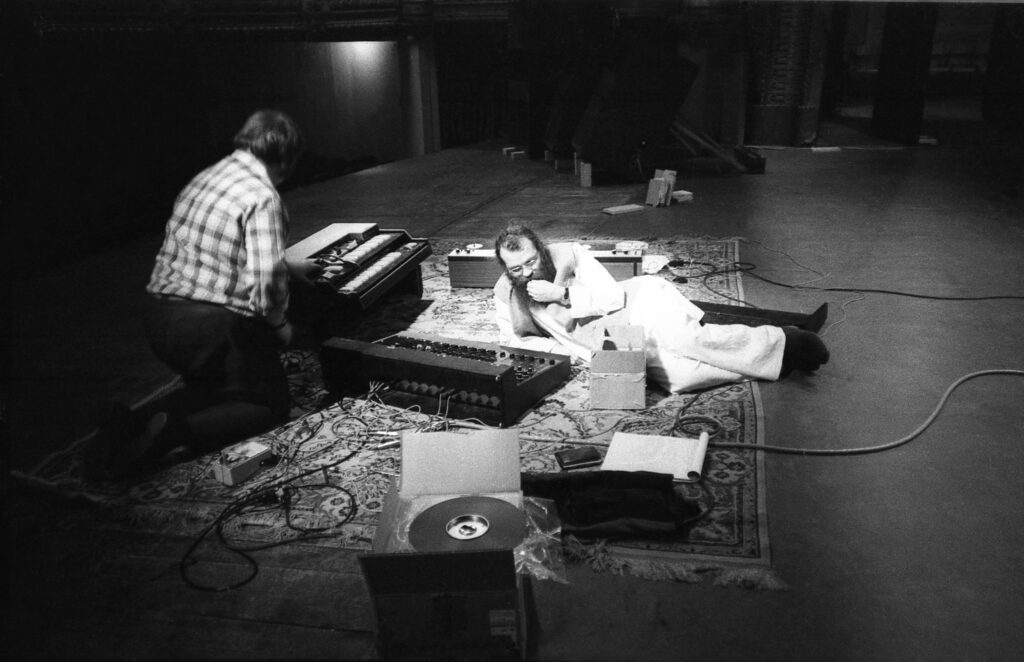
I first came into contact with drone through its “originator”, the New York minimalist composer La Monte Young, who during the 1960s began experimenting with sustained tones influenced by Indian classical music and instruments like the tambura and didgeridoo. In 1962, together with Marian Zazeela, Young formed the group The Theatre of Eternal Music—which also featured John Cale, Tony Conrad, and Terry Riley—focusing on “eternal” drones built from just intonation and subtle harmonic interference patterns. Their experiments would go on to inform artists ranging from My Bloody Valentine and Coil to Brian Eno, Spacemen 3, and Stars of the Lid. Once you hear it, drone is everywhere, coursing through Krautrock, shoegaze, industrial, and techno alike. Or as Marcus Boon observes, “wherever you could find a power socket or a generator, synthesiser-created drones provided a trance-inducing bedrock.”
Once you hear it, drone is everywhere, coursing through Krautrock, shoegaze, industrial, and techno alike.
Perhaps most immediately obvious in the genre’s genealogy is the raga—the Indian tradition of melodic improvisation performed on, amongst other instruments, the sitar, sarod, and bansuri—paid homage to by pioneering experimental figures Catherine Christer Hennix and Charlemagne Palestine. Indeed, Hennix studied extensively with Hindustani vocalist and raga master Pandit Pran Nath, whose teachings she frequently described as foundational to her sound world.
While the centrality of the raga cannot be overstated—particularly given that histories of the sonic avant-garde have so often been dominated by white men—here, I want to point to a slightly under-discussed facet: drone’s emergence in Western Europe through centuries-old folk customs and acoustic technologies, including the bagpipes, hurdy-gurdy, and monochord. These instruments have existed for millennia and, when played, evoke a sense of deep time, collapsing the distance between the far-off past and the rapidly evolving present.
A Feudal Hum
Within medieval Europe, drones held a significant presence. Operated pneumatically, vast pedal organs blasted out specific, harmonically related pitches. There was, obviously, no electricity, and so the cathedral itself became the amplification system: a resonant chamber saturating the congregation in rich overtones. Vocals too were important, with choirs delivering Gregorian chants or, by the 12th century, polyphonic works by composers Léonin and Pérotin, in which ornate melodic lines unfolded around a slow-moving plainchant tenor. To contemporary ears, these pieces can sound curiously “off” because their tuning is based on natural harmonic ratios rather than the equal temperament that came to dominate Western music from the 18th century onwards. To get technical: whereas modern tuning divides the octave into twelve equal semitones, medieval systems privileged acoustically “pure” intervals in which the harmonics interact more audibly, producing hovering resonances and beating patterns that seem to breathe, shimmer, and shake.
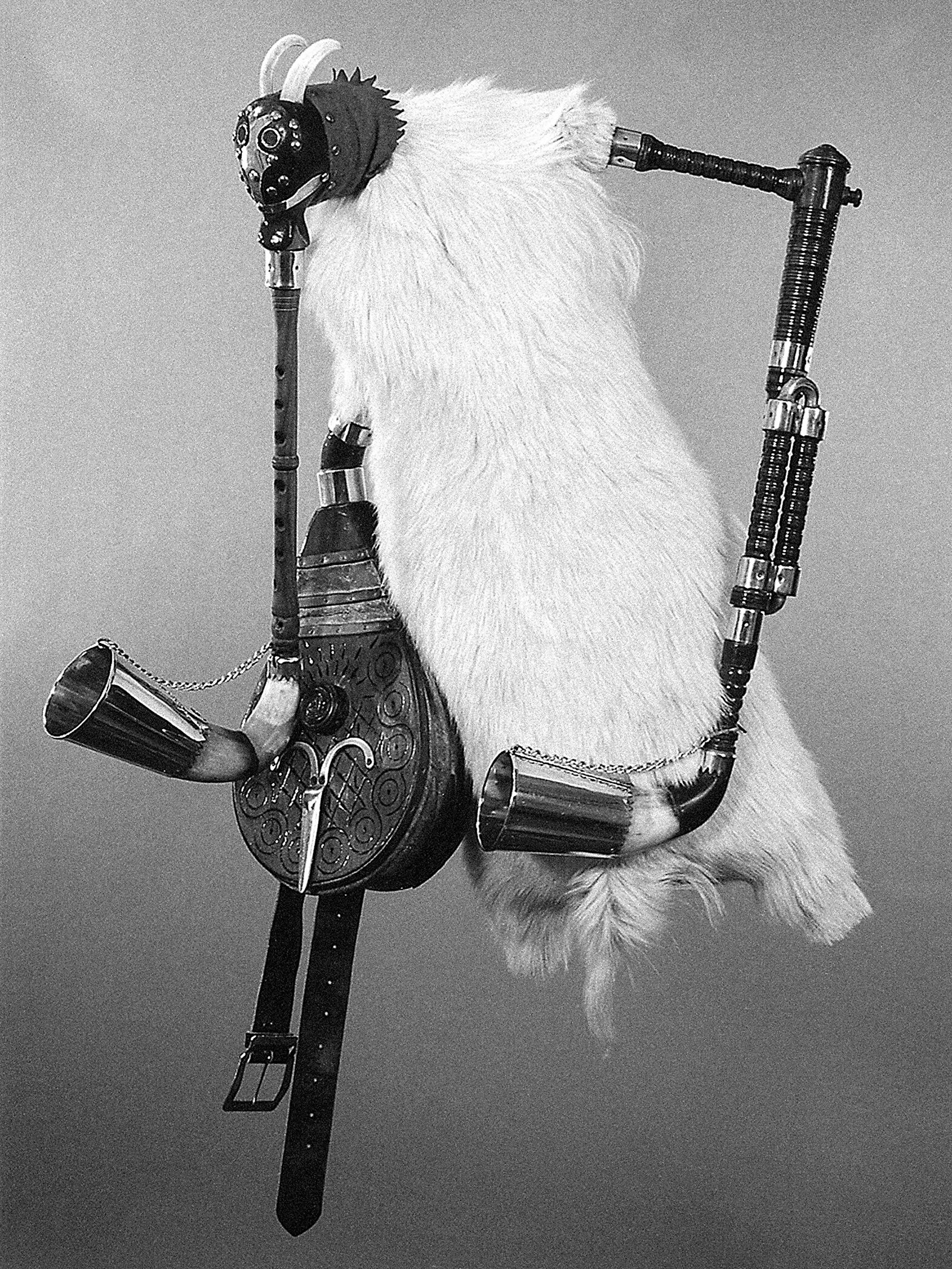
This legacy is especially audible in the bagpipes. Unlike the piano, whose pitches are fixed and standardised, the bagpipes operate through continuous airflow and sympathetic resonance, with the drone pipes—otherwise known as the bourdon—humming constantly beneath the melody chanter. Although the archetypal Scottish version has existed for only a few hundred years, bagpipes have appeared in various forms over the globe for far longer. Particularly striking is the kozioł of Polish folk, constructed from an entire goat hide—complete with fur and horned head—and producing a raw, buzzing timbre. As the Scottish musician Drew McDowall reflected in an interview with me, these tonalities can be “really strange and alien” to those accustomed to Western twelve-tone equal temperament.
Yet such sounds would once have been commonplace across medieval Europe, where the term bourdon—aptly derived from the French word for “bumblebee”—was used to describe a drone regardless of how it was produced, whether on the psaltery, vielle, crwth, or harp. The word remains part of the hurdy-gurdy’s anatomy today, where the bourdon string provides its wavering bass note.
Hellish Wheels and Cosmic Strings
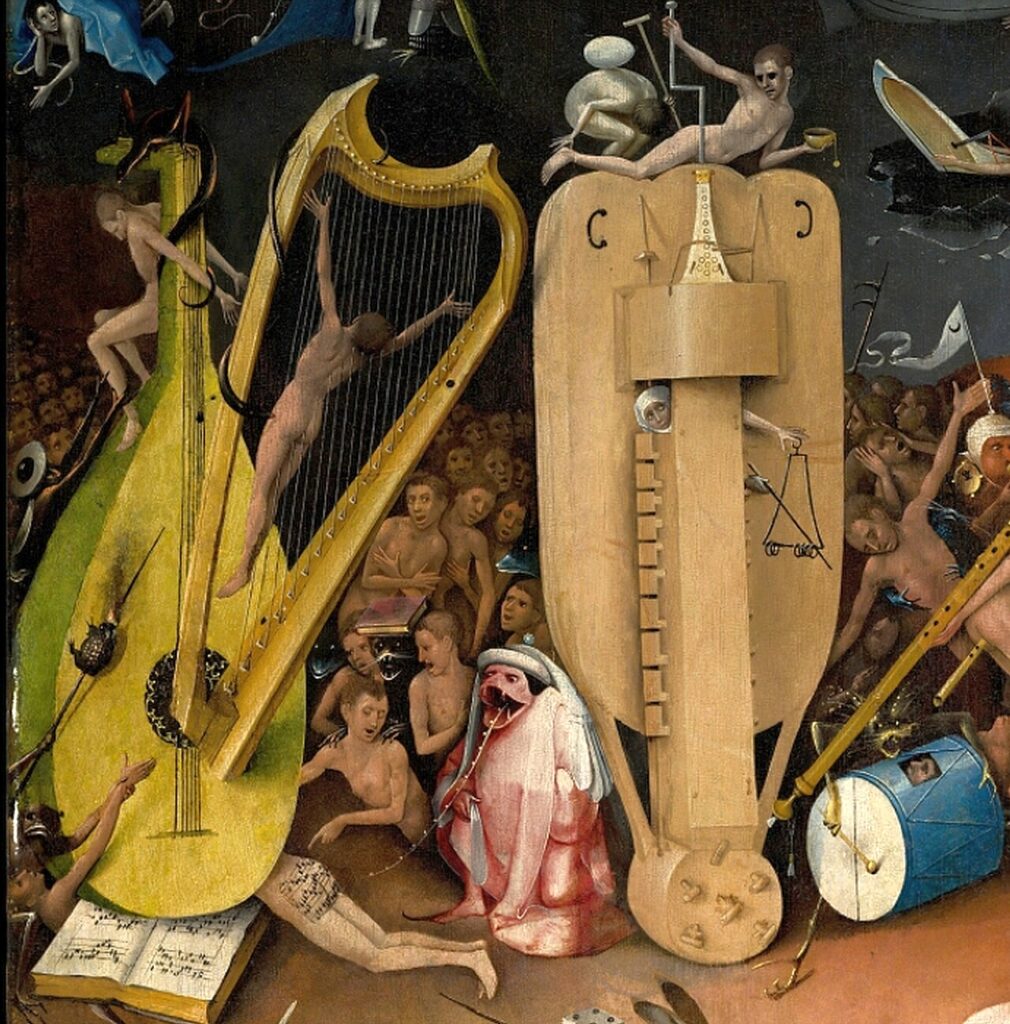
Resolutely steampunk in appearance, the hurdy-gurdy (or vielle à roue in French) consists of a hand-cranked rosined wheel, a violin-like body, and a small keyboard. Its origins are fascinatingly murky, although there is evidence that it has remained in use across Europe for over a thousand years. The English name is likely onomatopoeic, coined to mimic the whirring noise it generates. Deafeningly loud, the hurdy-gurdy is notorious for breaking speakers in recording studios and, when widely adopted by street musicians in Victorian England, provoking frequent complaints from the petty bourgeoisie. Perhaps it is precisely this disruptive potential that, as Jennifer Lucy Allan suggests, inspired Hieronymus Bosch to feature the instrument in his painting The Garden of Earthly Delights, in which “the soundtrack to hell is a giant and infernal hurdy-gurdy, accompanied by a large lute, a harp, and a man playing a recorder out of his bum.”
If the hurdy-gurdy is all bombastic power, then the monochord is its spectral opposite. Defined by its gentle, humming sonority, this sparse instrument is made from little more than a single string stretched across a wooden case. It is said to have been invented by Pythagoras in the 6th century BC, who, according to legend, used it to investigate why certain combinations of notes sound pleasant together. By changing the length of the string, the philosopher discovered that simple mathematical ratios could create pleasing musical intervals. When the string was divided exactly in half, for example, it produced the same note an octave higher, while other divisions led to intervals such as the perfect fifth.
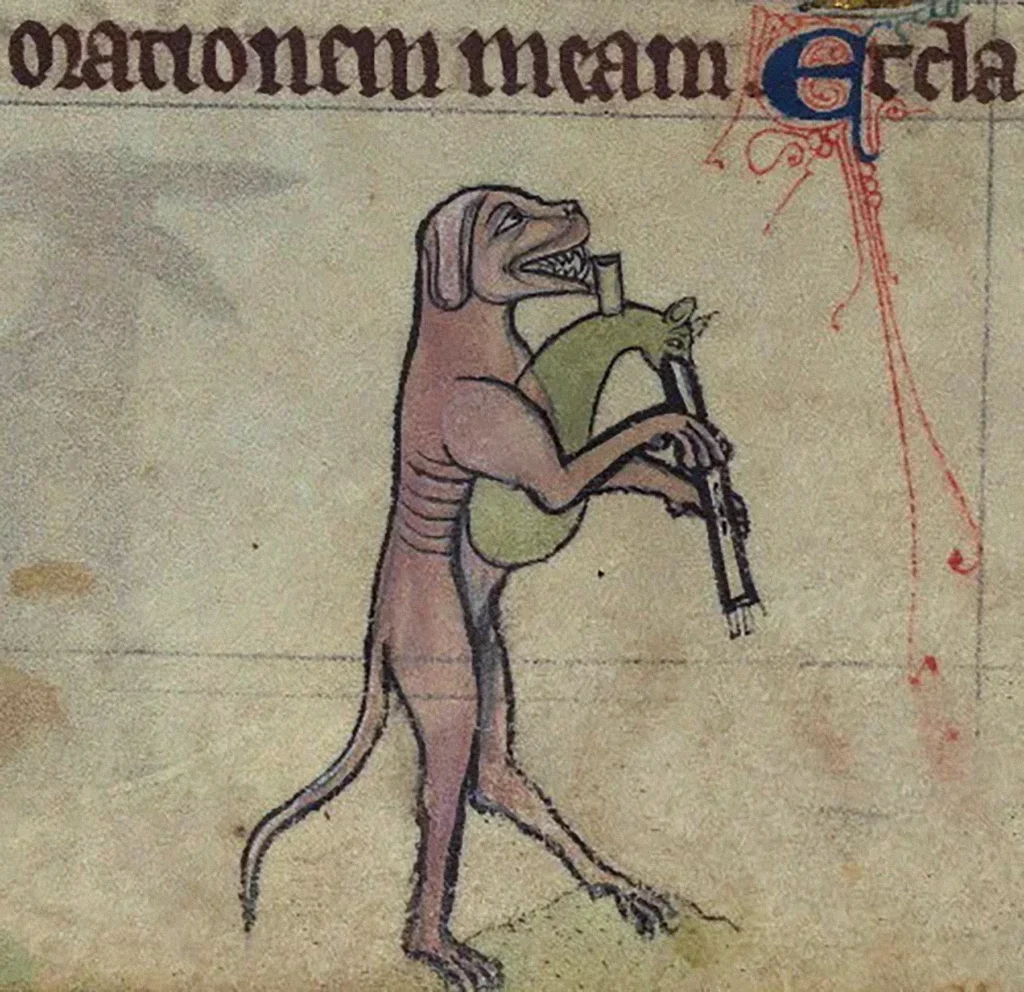
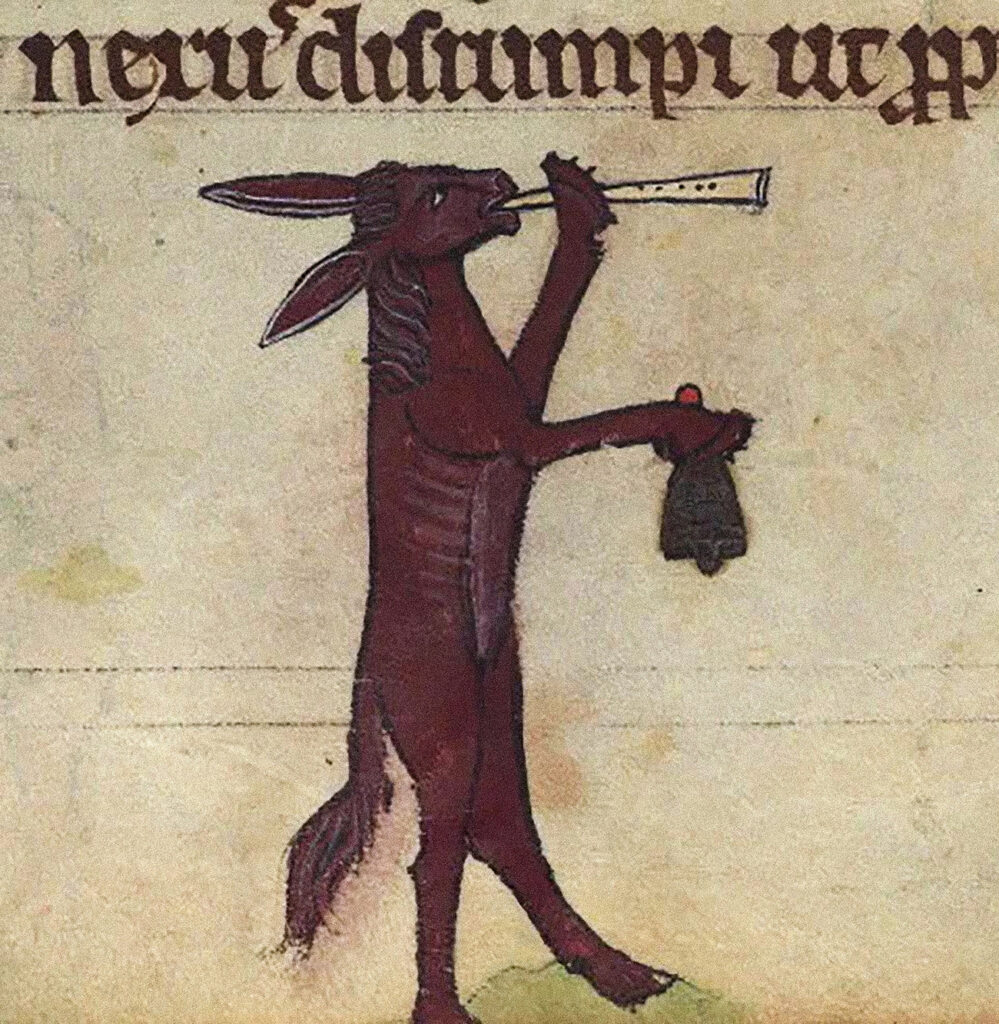
On the left: Dog playing bagpipes, detail from fol. 75v. From The Funeral of Reynard the Fox, 13th century. The Walters Art Museum.
On the right: Ass playing a recorder and bell, detail from fol. 75r.
For Pythagoras and his followers, these sonic proportions extended far beyond music itself. Harmony was understood as an essential principle of the universe, binding together mathematics, astronomy, and metaphysics. Throughout the medieval period, the monochord became an important pedagogical tool. Guido of Arezzo—the 11th-century theorist credited with developing an early system of musical notation—used it to teach chants and train singers. Its practical application continued well into the 19th century, when the monochord was employed to tune church organs. Nowadays, it is still sometimes used in educational settings to demonstrate pitch, and has been embraced by wellness and meditation circles: a minimal, droning technology through which sound becomes tactile, mathematical, and strangely cosmic.
The Future of Drone

In essence, what this brief history reveals is that the roots of drone run deep, although not in any pure or immutable state. Far from remaining static, drone has continually been reshaped and reworked over the ages, its elongated tones, disharmony, and drifting structures adapted to summon feelings of grief, ecstasy, devotion, and disorientation in radically different contexts. Indeed, there are many artists who, in recent decades, have reimagined the form through electroacoustic and digital techniques, reassembling older modes of transcendence and shared experience for an epoch marked by crisis and fragmentation.
A prominent example is Drew McDowall’s luminous album A Thread, Silvered and Trembling. Released by Dias in 2024, the record draws inspiration from the pibroch (or ceòl mòr), a Gaelic song for solo bagpipe. A type of lament, the pibroch became prevalent during the Highland Clearances—the removal and subsequent devastation of peasant communities by landlords throughout the 1800s to make way for profitable sheep farming.
Embedded within the drone lineage is a communal, ceremonial impulse, shaped through religious settings, collective gatherings, and modes of listening oriented toward the celestial and the sacred.
While, as McDowall notes, “I would absolutely not equate the Clearances to other experiences of forced displacement,” it is difficult not to read the themes of historical dehumanisation and violent eviction through the lens of genocide and ethnic cleansing in Palestine; the ongoing migrant crisis, and increasingly hostile architectures of borders and belonging.
Created through modular synthesis, digital editing, and tape manipulation, much of A Thread, Silvered and Trembling’s melodic material arose through a process of morphing and transforming recordings of bagpipe tunings, with certain passages of the album retaining the instrument’s characteristic dissonance. Contained within the keening call of the pipes is the rupture of a population dislocated from their home, the enduring grief, and longing for reconciliation.
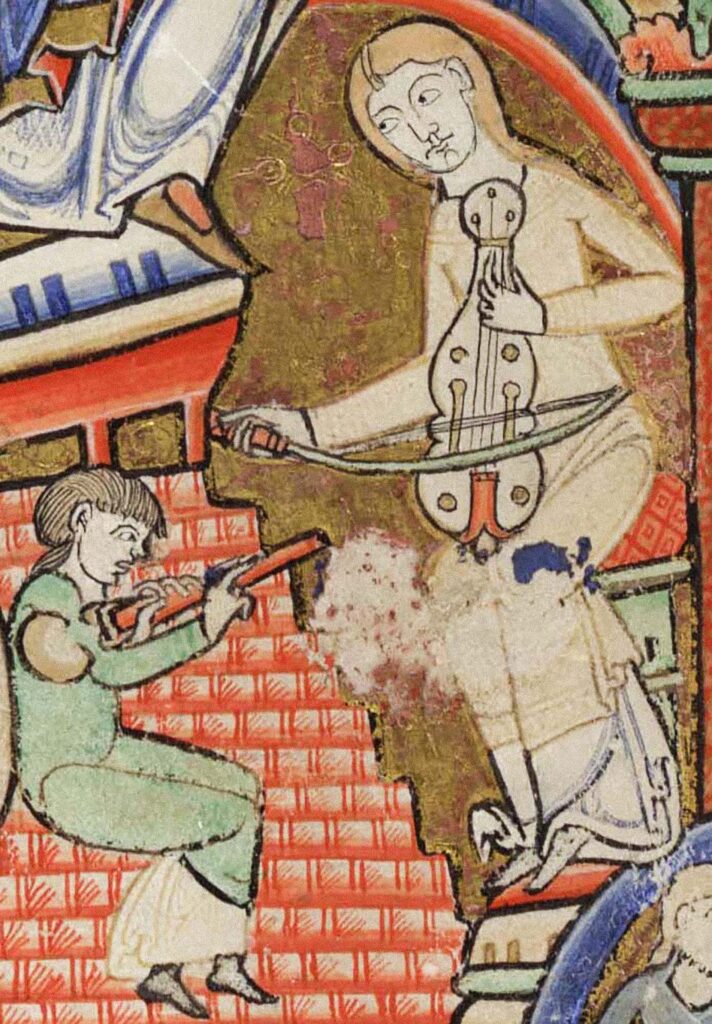

On the left: Vielle player with flutist, detail from Hunterian Psalter, Glasgow University Library MS Hunter 229 (U.3.2), folio 21V.
On the right: Woman sitting with hurdy-gurdy, Luttrell Psalter, England, 1325-40, British Library Add MS 42130, folio 81v. Wikimedia Commons.
Toward New Resonances
Embedded within the drone lineage is a communal, ceremonial impulse, shaped through religious settings, collective gatherings, and modes of listening oriented toward the celestial and the sacred. But drone is also punk: noise-driven, unpleasant, disruptive. In contemporary usage, the word “drone” has become an insult—shorthand for boredom or a lack of differentiation. And perhaps that’s true: for many, drones remain tedious, even annoying. I still recall, amused, leaving a concert by Kali Malone as a disgruntled audience member remarked, “But that wasn’t music—it was just sound!”
However, through its vibrational quality, drone also gestures toward something universal; it is always entangled with place, working in unison with the acoustics of the space in which it is performed, echoing across walls, floors, and bodies. In this sense, drone never entirely belongs to any one individual. It disperses authorship, unsettling distinctions between performer and listener, composition and environment. Perhaps this mutability is why the genre continues to endure. From wheezing sound machines to modular electronics, drone lives on: fluctuating, warbling, stuttering, tunnelling forward toward a vanishing point that never quite arrives.