Bodies May Be Arranged
Moving through his childhood memory, nightclub architecture and metaphysical theories of light, Vitaly Weber reflects on the dancefloor as a space where perception is reorganised. Centred on Milan’s A.R.X. gatherings, the personal essay follows how light and sound cease to merely illuminate bodies, becoming forces that orient attention, and transform collective experience into an almost ritual condition.
By positing light as absolute, monotheistic metaphysics introduces an element of over-exposure of Being to light—and this extends as far as the decline of matter through light; the gnostic motif of light being alien to the world is present here, as is the eschatological idea that, at the end of time, world and life are transcended in a final inner-Godly symphony of lights. **Then, light alone would be everything that exists, or rather, everything which, redeemed from existence, remains in eternal suspension.
— Peter Weibel, The Open Clearing and Illumination. Remarks on Metaphysics, Mysticism and the Politics of Light, in Light Art from Artificial Light, 2006
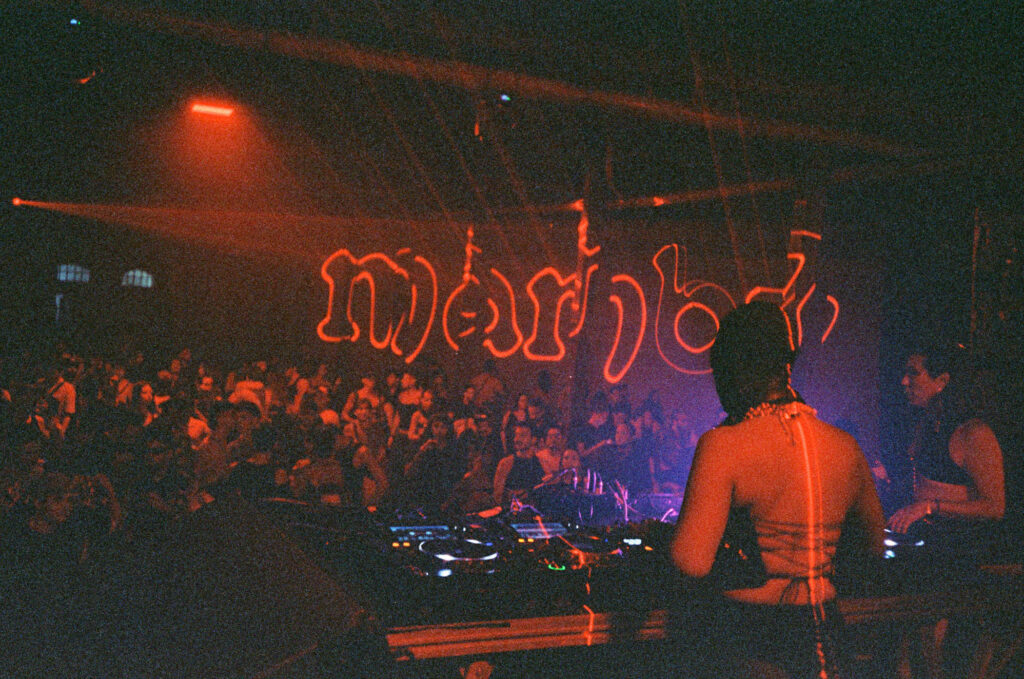
It is a warm spring morning in 2017; the month is May, the night is long, and it does not seem to end any time soon. For the past few years leading up to that moment, my body and spirit had been suspended: I had stopped being local in my home city of Kyiv and had not yet found my new self in Milan. The wearing-off effects of MDMA were directing my attention to the pulsing amalgamation of bodies on the dance floor, and to my almost religious devotion to partaking in this collision throughout the previous years. The building I was in looked like the kind of underground nightclub that seemed to exist only in late 90s films such as Blade, and this place suddenly became my haven. D&B C subs stacked on top of each other appeared to me as an active armour, like the kind found on modern armored combat vehicles used in the war in my home country; I was constantly, each time, fascinated by the coordination of the technology required to make these gatherings take place.
That morning, the neon light, with gas glowing inside its glass body, reminded me of the hours I spent after school in front of the TV, whose screen would illuminate the room in a vivid glow. When the sun had long gone, my living room in the old family apartment would be drowned in darkness, framed by the cold, diffused light beaming from the screen. Some days I would leave a blue “settings” page on, simply to continue with my evening, remaining for hours within this cold, diffused field. Light would structure the room, and allow me to position my body within it, not revealing anything beyond itself but operating as a continuous signal. There would be neither object nor subject in the room, but rather a condition in which perception was sustained and contained by a constructed presence that reflected attention while absorbing it. Light became an agent in my situational practice, and like me, anyone caught in the beam of inorganic light had no power over it except to turn it off or remove it entirely. In this sense, light asserted control over perception, shaping experience while remaining untouchable.
Light asserted control over perception, shaping experience while remaining untouchable.
In the Platonic tradition, vision depends not only on the eye and the visible object, but also on a third entity: light itself. Light makes vision possible, but it is almost never the object of attention itself; it enables appearance.
Around the time of A.R.X. no. 2, one of my former mentors implied that “the perfect lighting setup is invisible to the spectator.” This idea stayed with me, lodged in my mind as a total paradox: in a culture I perceive as an “event society,” deeply attached to materials, where every element is designed to be seen and consumed, light makes everything visible in an almost unnoticed way.
Most contemporary public gatherings in both pop and underground music culture position musicians as the central binding node within the space, reproducing hierarchical systems of attention control. Someone is always positioned above the audience, and the “stage” functions as an active signifier of the dominant position, with the spotlight targeting the performer. The spotlight functions as a device of separation, control, and the projection of power. The spectator is implicated, oriented, never fully master of their gaze.
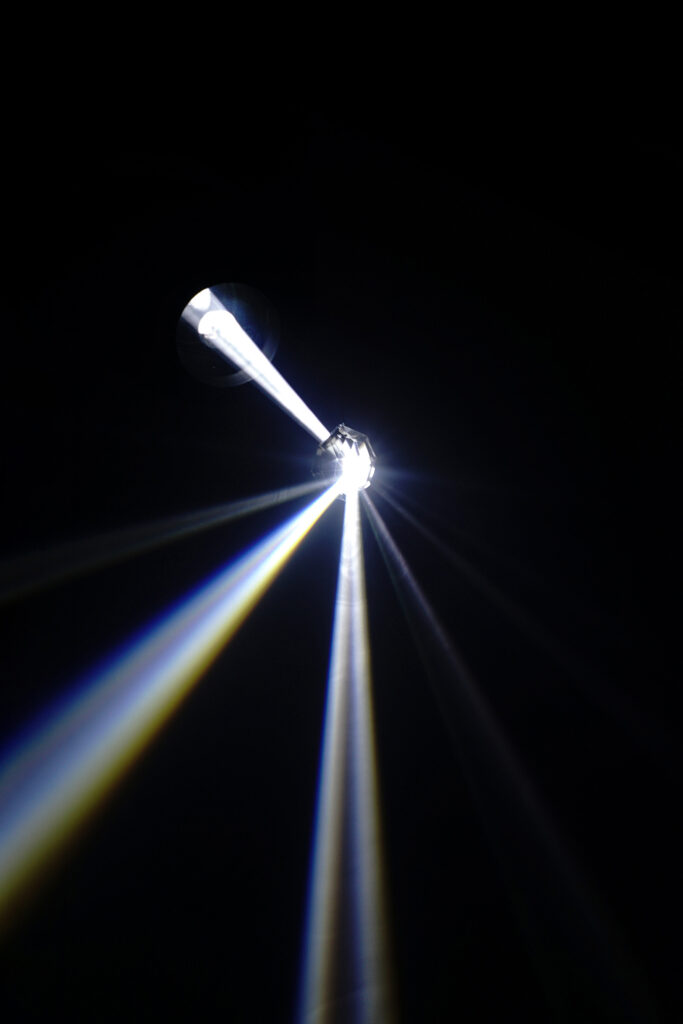

ARX n2 at C3 (23.09.2023). Photo by Vitaly Weber
In the moment before sleep, when a blank page seems to fold inward over the eyes, does one encounter an excess of light, or a “ghost” produced by the excess of light consumption? Or is it light itself, confronting the viewer with their own image and destabilizing perception?
The second half of the 2010s in Milan, up to the Covid-19 lockdown, was characterized by intense sound pressure and multiple forms of sonic acceleration of the senses. A.R.X. emerged as a way to make sense of the stark contrast between around-the-clock dance experiences and the void imposed by prolonged periods of quarantine isolation. The need for a space designed to consider the felt body as the primary object became particularly evident under these conditions.
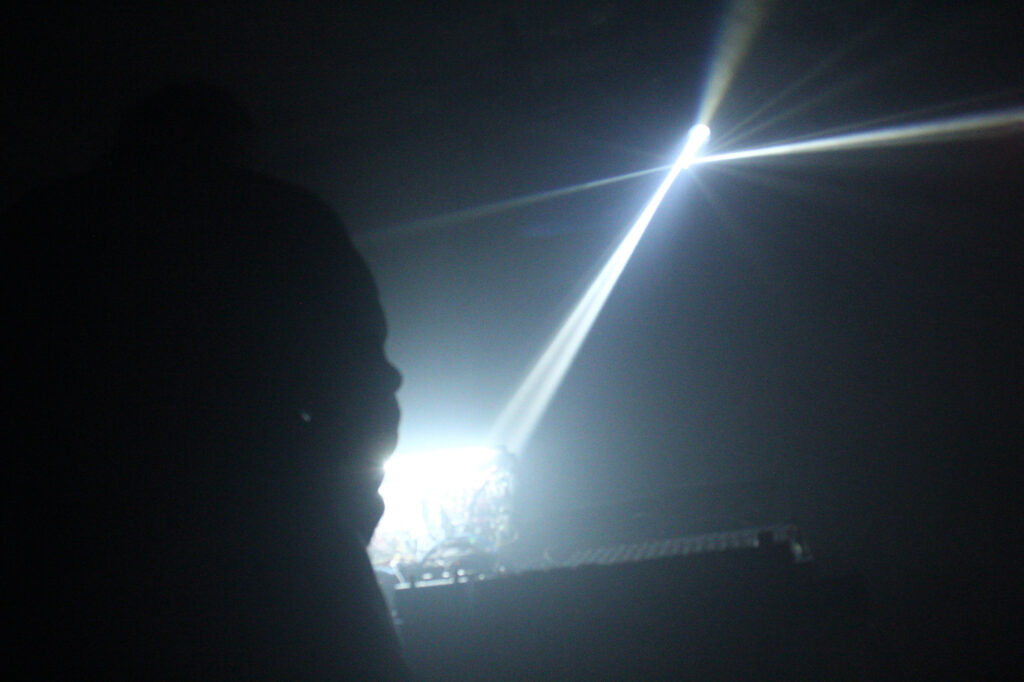
ARX n2 at C3 (23.09.2023). Photo by Vitaly Weber
The A.R.X. series became such a space: a site hosting gatherings of bodies suspended between external pressures and collective experience. The photological concept behind the entertainment lighting system was collapsed into a single motorized unit, as if returned to its “factory setting,” stripped down to its essential functions: emission and orientation. This reduction emphasized light as an agent that, together with sound, shaped participants’ perception and experience of the space.
The concentrated beam of a single spotlight produced a dominant image that captured attention while simultaneously reducing the visibility and perceptual relevance of surrounding elements, effectively becoming a “third entity,” an overseer of the space. A ray of light cut through the environment, only to be fractured by crystals—terrestrial energy set in opposition to the machine’s gaze—binding the audience within the interplay of light, darkness, and reflections inside the space.
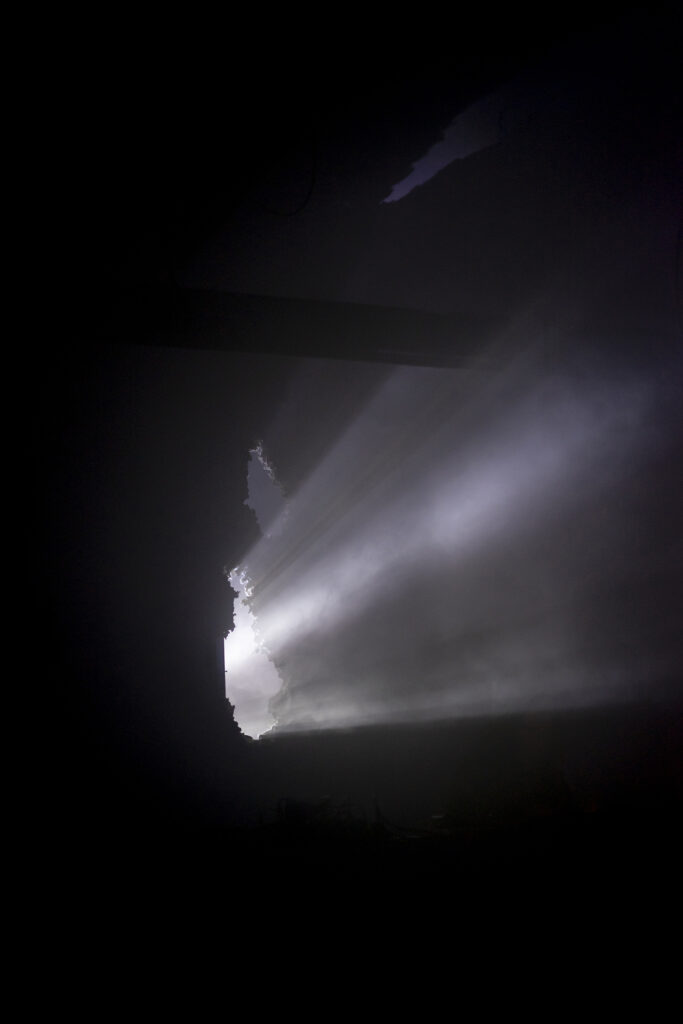
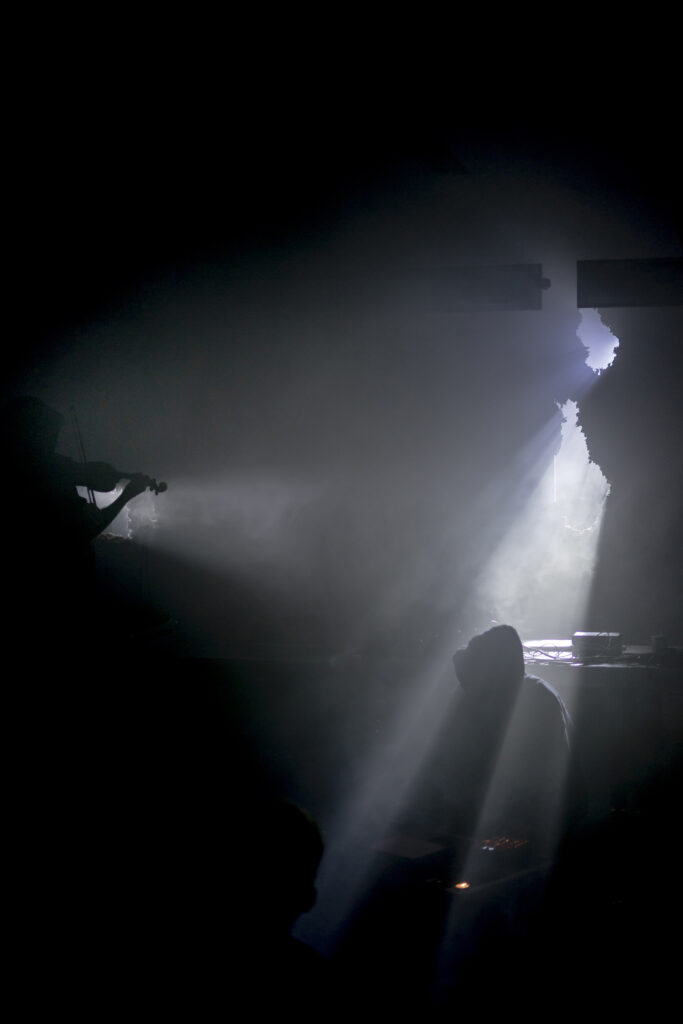
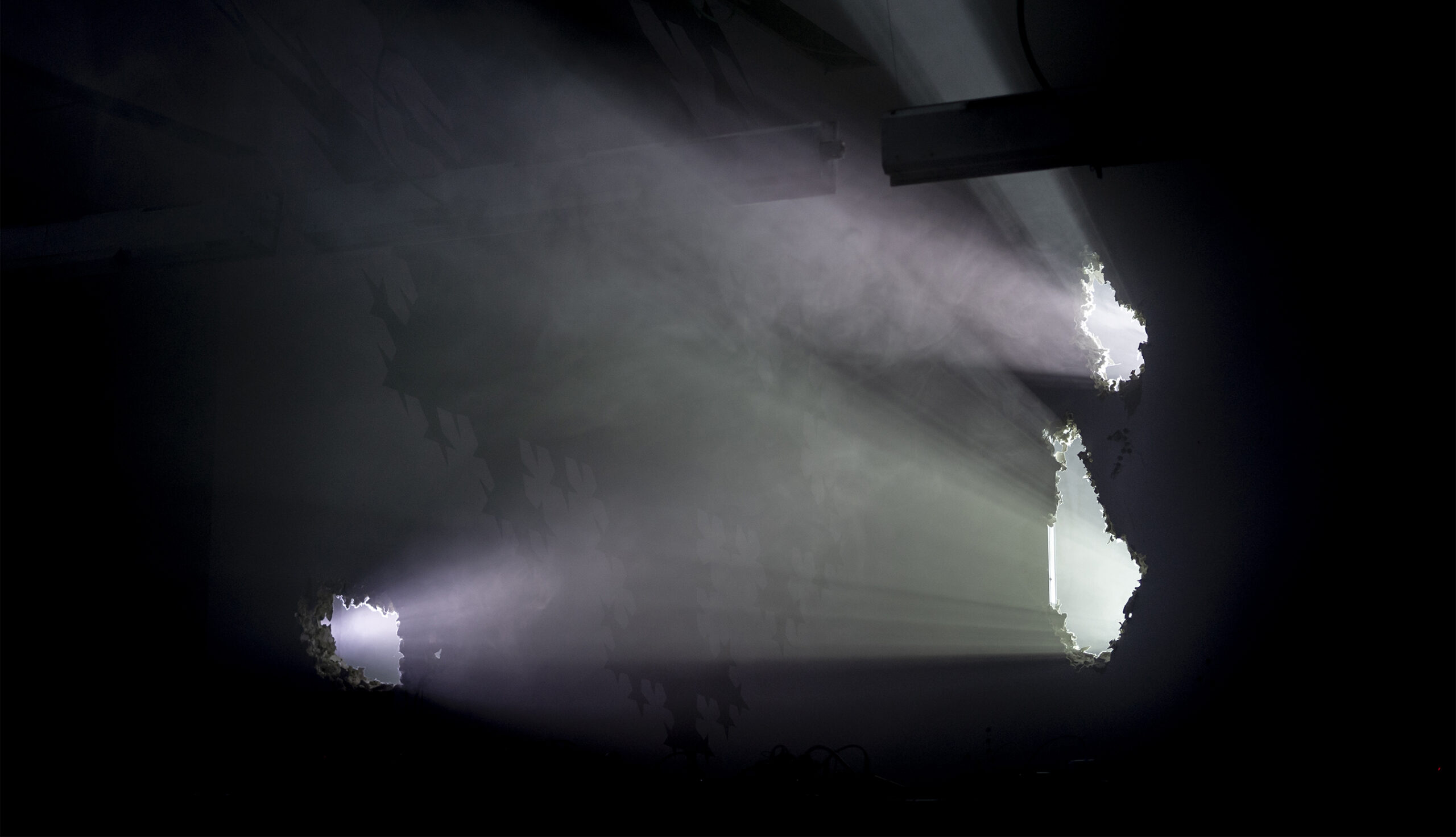
Arx n5 at Bim (5.10.2024). During A.R.X. no. 5, Vitaly Weber intervened in the office space by creating three openings in a plasterboard wall. Behind these openings, light sources were installed, allowing the beams to pass through the wall and propagate into the space via the newly formed channels. Photo by Aria Ruffini
Observed long enough, this ephemeral presence would assert itself as a mediator between material and immaterial, technology and the energy of sound, concentrating the spectator’s perception into a locus. The body of the lighting fixture would produce a continuous signal, not necessarily chasing a subject or revealing anything, but functioning as a “third entity,” progressing from technical manipulation to metaphysical presence. Over time, the apparatus withdraws, but the beam persists in the form of a supernatural aura. No longer read as the output of a machine, it assumes the quality of an autonomous presence, as if light itself had separated from its source and continued to operate beyond material constraints.
From metaphysical presence to technological control, light shifts from revealing reality to constructing and directing perception.
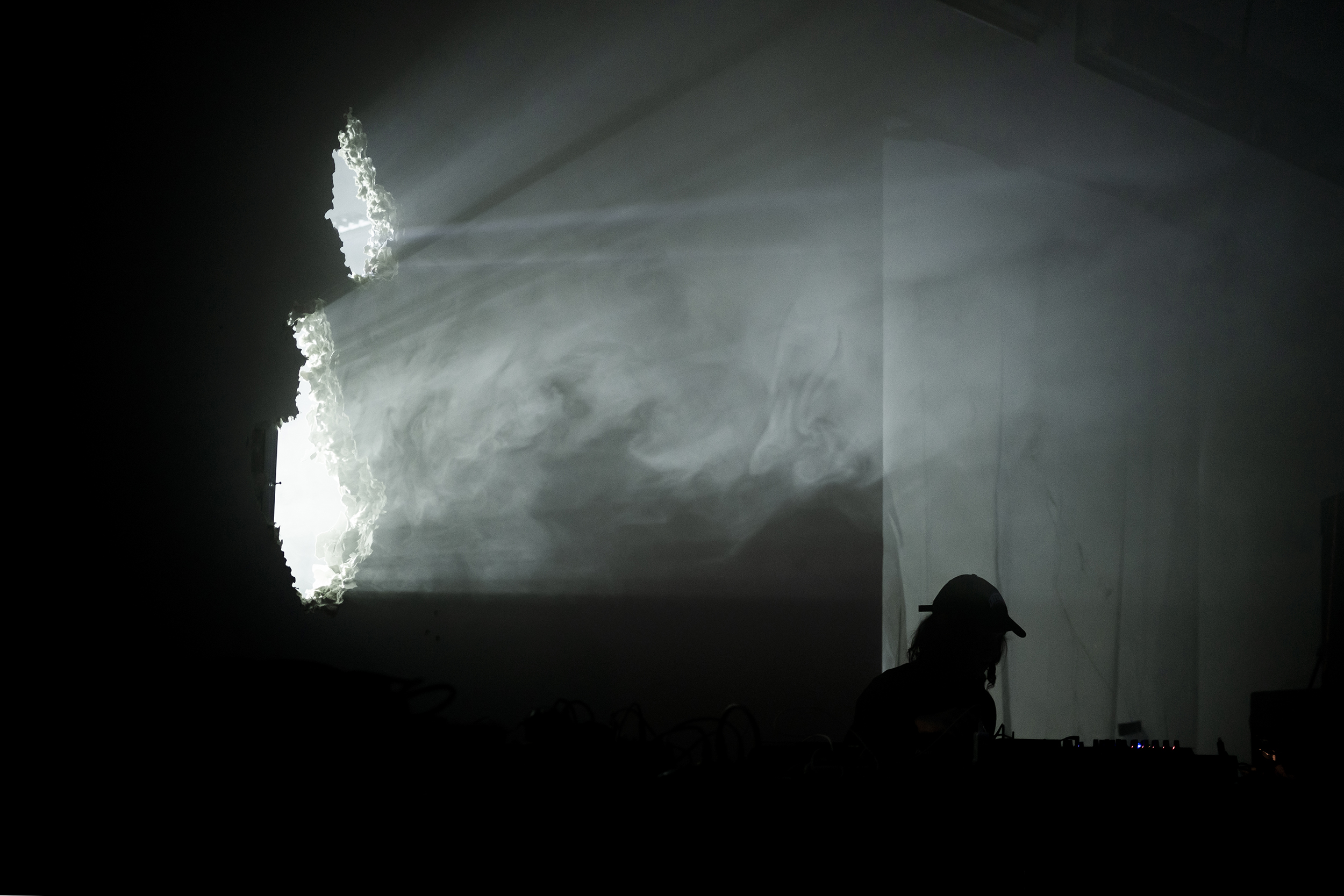
Arx n5 at Bim (5.10.2024). During A.R.X. no. 5, Vitaly Weber intervened in the office space by creating three openings in a plasterboard wall. Behind these openings, light sources were installed, allowing the beams to pass through the wall and propagate into the space via the newly formed channels. Photo by Aria Ruffini