Genderless Red Bottom

One of the most acclaimed voices in contemporary Thai literature, Duanwad Pimwana tells the story of Manop, an ageing man haunted by a love he never confessed. When a vivid dream brings back memories of Chaiyapon, the childhood friend he secretly loved, decades of silence begin to resurface. Moving between adolescence and old age, the story follows a life shaped by desire and compromise, tracing the quiet negotiations through which a kathoey identity was concealed and ultimately reclaimed. At the centre of this journey is the "chong kraben", a genderless garment that becomes both a memory of first love and a late gesture of self-recognition.
It was the day of my lamtat performance at the school fair. The chong kraben I wore for the stage made me feel wonderful. It was strange how easily my hands took to the task of putting on the chong kraben: wrap the lengthy rectangular fabric around the backside, pull both long ends to the front, bring in the two sides and tie them up tightly at the navel, pick up the ends from the floor, roll and gather them up into a tail, bring the tail back between the legs, reach behind for the tail’s end and tuck it in at the lower back, and then fasten a belt over it. I did these steps all by myself. The performance arts teacher and my troupe mates looked at me with interest, asking if I’d worn it before. I laughed and said, “Never, this is my first time; it’s just that I used to see my grandma wear it when I was ten.” After I put mine on, I helped the others. Our lamtat troupe had five boys and four girls. The boys wore the white student uniform shirt; the girls wore a light-coloured sash on top of the white shirt. The dark-coloured chong kraben was worn by both the boys and the girls. Did anyone else feel the way I did? This bottomwear was genderless, suitable for both men and women: a kind of wraparound lower garment for the girls, and a substitute for pants for the boys at the same time.
For the school fair that day, my sixteen-year-old self had written the lamtat lyrics and practised singing them for two full months with my troupe mates. As was tradition, the lyrics were comedic and just bawdy enough for a merry time. Our kids’ performance was only for fun, but it made me quite famous, especially among the girls. After the performance, we got down from the stage and changed. The girls washed their faces and wiped the makeup off. I washed my face but didn’t change out of my clothes, still enjoying having the chong kraben on. I walked all over the school, stopping to watch the Thai music ensemble under the rain tree. The dulcimer and zither players were very young girls from the elementary level; once they spotted me, they looked at each other and giggled bashfully. I continued walking to the canteen. My chong kraben was deep red, the colour of oxblood: it was impossible for anyone not to take notice. Finally I found the person I was looking for. He hadn’t been there at my show, because he was on the hoop takraw team currently showing off their kicks on the court next to the canteen. I stood watching and cheering from courtside, waiting until his show was over.
***
Chaiyapon had dark skin from playing sports in the sun. But he had striking features: both his face and his smile radiated a special gentleness, which probably had something to do with his tone of voice and manner of speaking. We were in the same class year but placed in different classrooms. After lunch, he and his classmates usually practised takraw until the end of midday recess. I had been watching him for a long time while having lunch in the canteen. One late afternoon I saw him practice alone: two or three bounces of the rattan ball before an inside kick to shoot it through the hoop hanging very high in the centre of the court. When the ball didn’t go through the hoop, he would run after the ball to retrieve it and go back to the same spot. Bounce, bounce, inside kick, run to retrieve, and repeat. One time I left my belongings on the chair and ran to retrieve the ball and entered the court.
“Hey big brother, I’ll be your practice partner. You can teach me,” I called him big brother even as I knew we were most likely the same age. He smiled gladly and kicked the ball back to me. We kicked it back and forth a few rounds before I miskicked.
He laughed. “Keep coming to practice, and you’ll get good. What’s your name?” he asked, his eyes fixed on the ball he was bouncing. “We’re probably the same class year.” He shot the ball with an inside kick. The ball flew gracefully into the hoop.
“It’s in!” I yelled at the top of my voice, clapping with so much joy that everybody turned to look.
Chaiyapon laughed heartily, his white teeth showing. He darted to the rope anchor, released the rope and slowly lowered the hoop. I waited under the hoop to take out the ball from inside the net. Chaiyapon then pulled the rope to hoist the hoop back to the same height. We continued playing for a good while until he suggested we go home. That was the day we became friends. I told him I’d be his practice partner again the next day.
“Hey wait,” he called out to me after we’d already started going our separate ways. “You haven’t told me your name yet.” I smiled timidly. I was embarrassed, very embarrassed; it was hard to explain why. “Manop,” I said, and immediately realised that I’d spoken too softly—he probably couldn’t hear me. “What was that?” he made a confused face, unable to make out any word. He stood in place waiting for a response. “MAH-NOHP” I repeated, this time loud and clear. I felt my face flush when he repeated my name back to me.
“MAH-NOHP. Oh I see, Manop. My name’s Chaiyapon,” he hollered. “I know,” I said and booked it home. On the way home, I couldn’t make sense of myself. I haven’t been able to make sense of myself since that day.
That unnamable feeling inside myself has been pushed down and barred from expression. I’m embarrassed, and I think that it’s not right. But try as I might, my actions continue to be driven by the whims of that inner force. Every day, Chaiyapon and I grow closer. The first day’s politeness gave way on the following day to the most casual pronouns. We’ve become best friends who are joined at the hip. Our friendship is genuine; we anticipate each other’s needs and support one another in everything. I am satisfied with this bond, so satisfied that I’d like this to continue indefinitely—maybe for the rest of my life.
Our friendship is genuine; we anticipate each other’s needs and support each other in everything. I am satisfied with this bond, so satisfied that I’d like this to continue indefinitely—maybe for the rest of my life.
***
Chaiyapon laughed when he saw that I was parading around in my red chong kraben. “Damn, I missed out on seeing you perform.” “How come you didn’t score at all? So much for all my cheering,” I complained out of the desire for others to see his talent, the way he could execute a kick more precisely than anyone.
“Before you showed up I’d already scored a few goals,” he said, “Then my eye caught your red chong kraben, so I got distracted. Took all my strength not to crack up. And then I scored no more.” He split his sides laughing when I affected a walk, putting my hands on my waist and swaying my ass from side to side. He was so tickled he couldn’t take another step; all he could do was grab his sides while hunched over.
“Go wash up and change in the restroom already. I’m hungry,” I dragged him by the arm so we’d get going.
At the canteen, I bought two glasses of longan drink. Big mugs, filled over the top line with ice, then the longan drink, which made the ice collapse a little. The drink seller was never stingy: she scooped out a full ladle of longan meat and turned the ladle upside down on the drink. The longan meat floating over the glass rim was my favourite part. Chaiyapon bought two plates of rice with a main. The main in question was spicy beef curry, the same for both. He liked beef curry. Me too.
“Eat up, you did a lot today,” Chaiyapon said. He first grabbed the longan drink and took big sips through a straw to quench his thirst. Then he stuffed his mouth with rice and curry. His jaws could only move twice before he choked. Covering his mouth, he coughed so hard his back heaved.
***
I cackled so loudly that I start awake. That world goes black. My heart drops. “Chaiyapon,” I let slip a call as if still hoping to bring back those images.
Someone stirs in bed close by. “Are you talking in your sleep, Old Man?”
That is the voice of Old Woman Pai, my consciousness tells me. I don’t respond, engrossed still in the dream from moments ago. It takes me a long time before I can fall back to sleep.
In the morning, I wake to the sounds of domestic life. I get out of bed and draw the curtains open. Fresh green foliage sways in the breeze outside. Pai is no longer in her bed next to mine. She always wakes up before I do. This bedroom doesn’t have that much space; one double bed would be the best fit for it. It used to be that way, but due to frequent waking in the middle of the night causing disturbance—when one woke up, the other would also wake up—by morning each of the two would have already woken up one or twice and would complain they’d gotten no sleep because the other was tossing and turning all night. The two’s daughter was the one to solve the problem by changing out the bed for two single beds, so her parents could sleep on separate beds. My bed is next to the window; Pai’s is close to the door. It’s better, but the problem isn’t entirely solved: since both Grandma Pai and Grandpa Nop still have good hearing, every time one stirs, the other will hear.
Pai, cane in hand, comes into the room. She started using a cane a little while back even though she’s only sixty-two, four years younger than I am. I can still walk by myself. Once she sits back down, I get up for my turn to use the restroom.
The loud voice of Jamjahn, my only child, calling her children downstairs to eat quickly, followed by her command to not be late for school: Jamjahn says that every morning before heading out with her husband to work. The sound from next door of the steel garage door rolling up, and the quiet moans of the motor of the large sedan: that means my daughter and her husband Banlue are now leaving their house. Half an hour later, my grandson, my granddaughter, and I meet at my car. It’s my job, my only job as a sixty-six-year-old man, to take the grandkids to school and pick them up after.
At eight-thirty, I arrive back home. With the adults at work and the kids at school, there remain the two seniors and the housemaid who begins her daily cleaning. Not wanting to be in the cleaner’s way, I ask Pai to go sit with me in the backyard. Grandma Pai grabs her cane and gets up, leading the way. I follow. Under the wide canopy of the two tall trees in the yard, Pai plops onto the nearest bench. I look for a good spot with dappled light shining through the leaves. That light falls on a bench three steps or so away from Pai. I walk there, take a seat, and look up at the shifting shadows of the sun through the canopy.
“Did you dream of my brother last night, Nop?” Pai asks from her bench. “I heard you call Chaiyapon in your sleep.” I turn to Pai and chuckle, amused at myself. “Was I being loud? What all did I say?”
“You called out to Chaiyapon so loudly it startled me awake. Did he visit you in your dream? How was it—was he doing well?” Chaiyapon died of illness last year. This was the first time I dreamed of him.
“I dreamed of my childhood, my friends at school, the school fair where I performed lamtat,” I said, surprised by my own recollection. Nowadays I’m pretty forgetful, can’t remember much about anything, but the dream last night was so clear it didn’t seem like a dream, but rather a scene from my past that came rushing back.

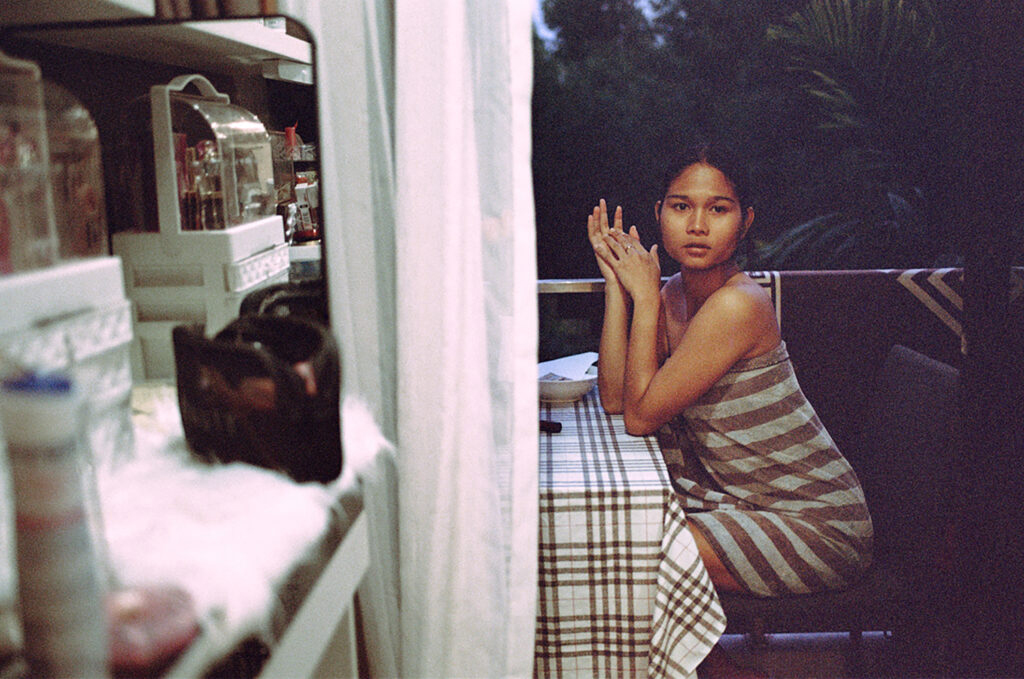
On the left: Nadia in Pattaya City, Thailand, 2023. / On the right: Chrissy at Home, Pattaya City, Thailand, 2023.
“You called out to Chaiyapon so loudly it startled me awake. Did he visit you in your dream? How was it—was he doing well?”
Pai blinks slowly, probably in an effort to think. Her body is feeble and sluggish, but her mind is still sharp; her memory is in much better shape than mine. After taking the moment to think, she cries out, “Oh-ho! You dreamed of your time in school, way back then?”
“That’s right, the school where we studied, Chaiyapon and I. Back then there weren’t any real buildings, only wooden structures, even for the canteen. Nowadays they’ve all turned into buildings. That rain tree is probably the one thing that might still remain.”
“What about me? I wasn’t there in the dream at all?” Pai asks. “Not really. I didn’t see you,” now it’s I who need a moment to think, “Wait, you weren’t in school with me. This was probably from when I hadn’t gotten to know you yet, Pai. I knew Chaiyapon months before I knew you.”
Pai nods slowly. “Mmm, that’s right, I went to an all-girls school. Tell me, in that dream, was my brother doing well? Did he want something? If there’s food he wants, I’ll make merit for him with it.”
“He was doing well,” I said, “In the dream he was playing takraw. I stood watching him from courtside. After that we went to eat. He had spicy beef curry on rice. I had the same thing.”
“Spicy beef curry,” Pai repeats, “That’s unlikely. He stopped eating beef a long, long time ago.”
“As did I. I stopped eating beef a long time ago. Don’t know why we ate it last night,” I mutter as if puzzled, while in fact it makes perfect sense to me, because during that time we hadn’t yet quit eating beef.
“Oh right,” Pai says like something occurs to her, “When I was a child my mom liked to make spicy beef curry, and P’Pon really liked it, I remember that still. I wouldn’t have any of it; I didn’t like spicy foods. Maybe he misses Mom?” Pai falls silent for a while before continuing, “For the next sacred day I’ll look for spicy beef curry to make merit for him.”
I look up, trying to find the shifting ray of light from moments ago, but it’s gone. I knew full well there was only a small window of time to watch it, and yet it slipped my mind.
The light has disappeared behind the leaves. The present moment for us humans, how many seconds does it amount to? I let it all slip away from my grasp. One moment, the next moment, on to the next moment, gone to nothingness like the wind.
***
The dream I had last night was so clear it didn’t seem like a dream: it was a memory where I hid away a version of myself. That lanky, light-skinned boy with a pretty face still lives inside me, shut away in a secret corner of a life. That teenager is still cheery, gleaming, brimming with the life of youth, and still full of love to give. The love that puffed up and spilt out in every movement. How strange, I’m the one who imprisoned him, disallowed him from existing, from making an appearance; I did it for so long that I thought I’d squashed it, that I’d managed to squash him into nothingness. But now in old age… suddenly he’s back, as if he forced open the bars keeping him in my subconscious, as if he wanted to defy and let me know that he’s survived, that he’s never gone anywhere.
But what’s the use now, when old age is all I have left? My youth ran out. I’m merely a retired old man whose job is taking the grandkids to school and picking them up after. Even though the world today is accepting and welcoming, it’s too late. I betrayed myself until I had no time left for any more second chances.
In my youth, I tried many times to reveal myself. I loved Chaiyapon, had a crush on him even before I got to know him, so the desire to reveal myself began rising like a bubble propelling itself upward to the water surface. But the desire was accompanied by the fear of losing it all. If the feeling wasn’t mutual, our friendship might prove unsalvageable. That is why, in each and every moment where I had to make a choice, I never chose myself.
Between Chaiyapon and me, we were equally popular among the girls. Being an object of female attention was familiar to both of us. An all-girls group of admirers followed Chaiyapon everywhere, both at practice and at competitions. In that group there was a pretty girl who often stood next to me while cheering him on. Her name was Saichon. She showed up for Chaiyapon the most often, but all her friends knew that her real target was me. My usual response to the attention would be to banter with the girls and move on; all of them knew I was never serious with anyone. But this girl, Saichon, wasn’t playing. Her seriousness made me uncomfortable. Her gaze was charged with meaning every time she looked at me, and she didn’t hide it. Soon, all her friends could tell, so they began teasing her and trying to pair her up with me. Chaiyapon also joined in. Oftentimes, Saichon smiled sheepishly at the teasing. But I wasn’t having it, so I let my irritation show and tried to distance myself from her. That was the first time I did something to hurt a girl and made her cry. Saichon stopped showing up, but it wasn’t long before she returned to the courtside just for Chaiyapon; she didn’t pester me or try to come up to me again. I was relieved like a mountain had been lifted off my chest. Little did I know that the real tragedy had just been set in motion.
I didn’t have the guts; cowardice and fear were stronger than my resolve. It all went wrong from the start. Because I chose to hide it, to reject myself.
Chaiyapon was always courteous and careful with his affections. A lot of girls had a crush on him; some of them could make him blush, but none could make him fall in love. Chaiyapon guarded himself from love, but he was very giving otherwise. He felt bad for Saichon, spoke to her with extra gentleness, as though he felt the need to shoulder my responsibility for hurting her. And then their bond strengthened day by day; I witnessed everything. Outwardly I was indifferent, but my insides were burning restlessly. I fought with myself nightly, resolved many times to confess my feelings, but every time I came face to face with him I abandoned the idea. I didn’t know how Chaiyapon felt. Never asked what he thought about guys who loved guys, or whether he accepted kathoey. I didn’t have the guts; cowardice and fear were stronger than my resolve. It all went wrong from the start. Because I chose to hide it, to reject myself. Making that choice meant I shouldn’t allow myself to fall for any guy. It was all too late to fix at this point. Chaiyapon had clearly shown he was into girls. I must accept it and let life play out. We could only love each other as friends. My love for him could only be a secret; a silent, solitary torture. I still remember that feeling clearly, that hard-to-forget taste of heartache.


On the left: Pangtini and Friend in the Dressing Room, Pattaya City, Thailand, 2024. / On the right: Pangtini on the Beach After Work, Pattaya City, Thailand, 2023.
***
“Let’s go inside, Old Woman. I want to take a little nap.” Amenably, Pai grabs her cane and pushes herself up from the bench. It seems she was already waiting to go back inside, but she didn’t want a nap as I do. She sits back and watches TV in the living room at the front of the house.
I get to my bed and fall into it in a heap. I want to fall asleep right away, but can’t. My heart is so excited by the thought of Chaiyapon it’s under stress. I want to go back to dreaming, to seeing him like last night just one more time. Except, I can’t sleep. As tired as I feel from the heaviness in my heart, this time of day before noon is too early to catch some sleep.
I was hoping that I would be able to fall asleep in the hours after lunch. Still, I don’t fall asleep, even though I’m fond of taking naps during the day. My mind is racing with thoughts of its own, trying to rummage through old memories—and that’s no easy task, to say the least. How maddening, all the organs of my body are still going strong, but my wretched memory has become senile far beyond my years.
In the late afternoon, while on my way to pick up the grandkids, I feel particularly tired, so I have high hopes that tonight I will sleep like a log. I wish myself good dreams.
It happened. I fell asleep soon after sunset, and slept like a log. However, I didn’t dream of the person of my desire. Nothing happened last night. Actually, I did not dream at all.
I wait. Every night I go to bed hoping. And every morning I find myself muttering the same words, “Nothing happened last night.”
***
Pai flips through the calendar hanging over her headboard. “Tomorrow’s the day, Old Man. Sacred day. I’ll find beef curry for some merit-making.” That’s not an invitation, but an order. She says that to me specifically so I am prepared, because any day she goes merit-making is a day I can’t drive the grandkids to school. Banlue will have to do it, as I will be driving Grandma Pai to the temple. Done with me, she calls out to the housemaid to task her with finding the spicy beef curry.
“Pai, about that spicy beef curry,” I decide to say, “why don’t we switch to something else? You told me yourself he stopped eating beef a long, long time ago. I can confirm that ever since he turned thirty and up until his death, he never touched beef again.”
Pai goes silent for a moment. “Then why did he eat spicy beef curry in his dream visit? Doesn’t that mean he wants to have it again?”
“That was a dream. How can there be anything to it?” I shake my head. “You’re going to make merit for him with a food that you know he stopped eating a long time ago. It’s a sin. Let’s change it.”
“So, what food would he like?”
“How about shrimp vegetable soup. He did like that.” Pai nods and turns to order the housemaid, “Go to the food shop at the street corner, order one pot of shrimp vegetable soup, and tell them I’ll pick it up in the morning. Also bring a loop handle pot for them to put the food in.”
Pai is my companion through thick and thin. She is another true friend of mine, no less than Chaiyapon was. I have done her so much wrong. I should confess and ask for her forgiveness for my karma. The upcoming trip to the temple presents a good opportunity.


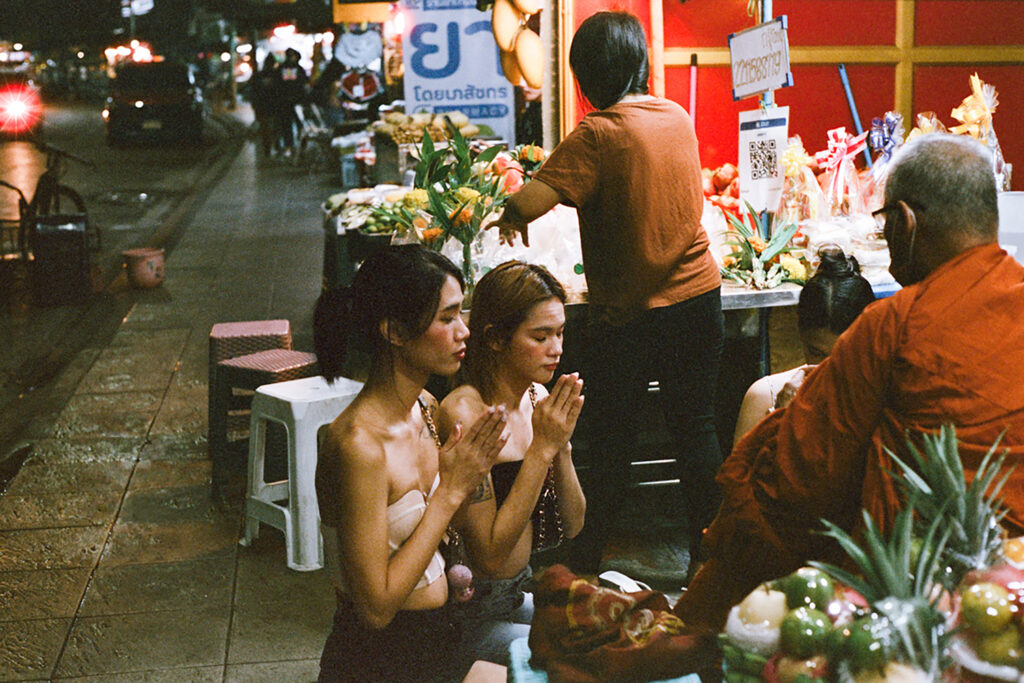
From left to right: Chrissy and Friends on the Beach After Work, Pattaya City, Thailand, 2024. / Maria at a Fruit Stand, Bangkok, Thailand, 2023. / Nat Bam and Faye Making Merit with a Buddhist Monk, Pattaya City, Thailand, 2023.
***
In the afternoon, I ask Pai to go with me to the fabric market to find each of us a chong kraben. Pai chooses a light purple fabric. She says she’ll wear it with the magenta silk lace blouse that our daughter gifted her the other year. I tell the shopkeeper to bring me two belts to go with the bottoms.
Pai looks at me and says, “Are you buying me a rose gold belt?”
I chuckle and tell the shopkeeper, “Just stainless steel, please.” Pai has a good long laugh at my expense.
“I also have beautiful chest pins, Grandma,” the shopkeeper opens her box of pins, turning to me. “Grandpa, you want to buy her some?” I lean over to look. Picking one, I hand it over to Pai, “Here, pin this on your lace blouse.” Pai grins with joy, tries placing it on her chest, and tells me I have a good eye.
For myself, I pick oxblood red fabric and a white shirt. “I have a lot of beautiful sarongs already. Nop, why do you want me to wear a chong kraben?” Pai complains about my outfit request for the temple.
“Do it so I have a friend. That day in my dream I wore a red chong kraben when I watched Chaiyapon play takraw. He saw me and couldn’t stop laughing. He looked so happy. I want to put it on for him to see.”
Once back at home, we practice putting on the chong kraben. Pai says that in all her years and through all the theatre and opera shows she’s seen, she’s never learned how to put one on. So I teach her from start to finish. Pai looks excited but also embarrassed.
“Nop, are we really going to dress like this to the temple tomorrow? I’m embarrassed thinking of our kid and grandkids.” “Embarrassed for what? Both of us will wear it. I’ll take the lead; you can walk behind me.”
The next morning I do as I said: in my red chong kraben I head first to the car with Pai behind me. Our granddaughter Khaopoad gets excited and follows us to the car. She gushes, “You’re so so beautiful, Grandma. Next sacred day, if it falls on a day I’m off from school, let me go to the temple with you, please?” Pai gives her a hug before getting in the car. Khaopoad waves bye-bye and walks to her dad’s car, where her mom and younger brother are waiting.
I am fixated on the upcoming moment when I’ll broach the subject with Pai. Today, inside a temple, in the presence of monks, I, who adhere to Buddhism, will not lie, absolutely not at this time and at this place. After listening to the monks’ chanting, after giving the alms of rice and shrimp vegetable soup, and finally after the pouring of water to dedicate a part of the merit made, we leave the ceremonial hall and beckon each other to sit under the gardenia tree in front.
“I have something I need to confess to you, Pai.” Pai tilts her head my way, waiting for more. “Confess what?” she makes a confused face.
“The day I asked you to marry me, do you remember it? I was a little over thirty; you were twenty-seven. I randomly ran up to your house, called you to the bottom of the front steps, and with no rhyme or reason, asked you to marry me.”
Pai looks up, her gaze lost in the distance as she tries to remember, which must be hard to do, since that day is more than thirty years past. “The day you asked me to marry you… Oh yes, I remember. Let me try to recall. I remember that I was completely taken aback, and thought it very strange, too, because I’d always had the impression that you didn’t like me, that my love for you was unrequited. I’d spent years chasing you, trying to win you over, and already figured it to be a lost cause. But one day you ran to my house; I don’t know from where, but you were soaked in sweat. I heard you call my name, which surprised me because every time you’d come before, you would call for Chaiyapon. My brother and I opened the door and saw you standing with a panicked face. You asked to talk to me. Chaiyapon was surprised, too, but he knew how I felt, so he nodded for me to go downstairs and talk to you. Are you speaking of this? You’re going to confess that you did not, in fact, love me, aren’t you?” Pai says. Her memory is really impressive. She turns to give me a smile like it’s funny.
I sigh. “If you already knew that I didn’t love you, then why did you agree to marry me?”
“Because I had feelings for you—come on, you know that. At the time I thought that, actually, deep down you had some feelings for me, too, but you didn’t want to show them,” Pai laughs. “So what’s the use speaking now? Are you thinking of divorcing me?”
Now I laugh. “As if! Divorcing you will leave me dying of loneliness. You are a true friend of mine, my last ride-or-die actually. I have to confess because I’ve done you wrong for a long time. I want to ask for your forgiveness for my karma, Pai. I’m going to tell you today why I asked you to marry me.”
Pai waits in silence. She knows I’m being serious, and she may in fact have been waiting for this for a very long time. “At that time I didn’t love you because I was already in love with someone.”
“Who was it?” she immediately asks.
“Chaiyapon, that’s who,” I reply. “I was secretly in love with Chaiyapon; that’s why I never paid attention to any girl.” Having let out the truth, I watch Pai. She stays quiet and looks straight ahead, probably in the middle of connecting the dots. “I didn’t want to accept that I was kathoey, so I kept my feelings private. I couldn’t tell Chaiyapon either; I was afraid he was going to stop being friends. Then Chaiyapon began seeing someone. When I saw that he liked girls, I kept even quieter. I could only love him in secret all these years. I was heartbroken when he had his first girlfriend. Chaiyapon hadn’t finished school yet, so he didn’t think he could commit to more. He told the girl that he wanted them to get to know each other more first, and that he didn’t have money, so he wanted to work and make money before committing to a serious relationship. But the girl was impatient and wanted to move fast. Seeing that Chaiyapon wasn’t in a rush, she eventually broke up with him. Chaiyapon was pretty crushed by it; that was his first love. I was by his side, the friend who comforted him. Inside, I was jumping for joy, like there was hope again. What was I hoping for? I tried to keep him to myself; I didn’t want him to be in a relationship, but was still too much of a coward to declare my feelings to him, and only hoped against hope that I would be able to keep him from leaving my side for the longest possible time.
“I didn’t want to accept that I was kathoey, so I kept my feelings private. I couldn’t tell Chaiyapon either; I was afraid he was going to stop being friends.”
“After secondary school, Chaiyapon went to a teacher training college, while I went to be a trainee at several places until I landed a clerical job at a printing press. We drifted apart. The times we could see each other were few and far between. Whenever I missed him a lot, I would swing by his house to ask how he was doing. Sometimes I sat down with your mom, sometimes with you, just to hear any little bit of news about Chaiyapon.”
“I thought you came by to flirt with me,” Pai finally opens her mouth. It seems like she can stomach it; there’s no sign of dismay or upset like I worried. “Now it makes sense: you kept coming to my house to hang out, but whenever I made a pass at you asking to go out together, you never said yes.” Her tone is slightly mocking, but more friendly than it was serious.
“Please don’t be mad. I didn’t want to deceive you, so I didn’t go with.”
“Haven’t you been deceiving me for almost forty years? Instead of giving it to me straight, you went for marriage.” “When I asked you to marry me, it was because Chaiyapon had gone steady with a girl again. He’d finished college, had a job, had a girlfriend, and began talking to me about wanting to get married. So I began spiralling. My thoughts ran wild like I was going crazy—at once devastated, slighted, and wanting to act out.”
“Oh, so that was the reason you asked to marry me: you just wanted to act out,” Pai starts to raise her voice. “No, no, no, that wasn’t me acting out. I had a different reason for the asking. I did a lot of mulling over: my impression at that moment was, I was really about to lose Chaiyapon, and um… I knew that you had a thing for me. You were Chaiyapon’s little sibling; you would be an excellent bridge connecting me inseparably to him. Marrying you would turn me into close family, a friend who was also a little-sibling-in-law. I just… wanted to be as close to Chaiyapon as possible. And all this time we’ve been together, I can talk to you about Chaiyapon as much as I want, which is such a nice thing. I could never have married anyone else, including Chaiyapon. You are the only one I could share my life with. We’ve always gotten along well; you’ve been the best wife I could ask for, and as good of a friend as Chaiyapon was to me. Please don’t be mad, Pai. I’m here today to try to apologise to you; I gathered all the courage I had in reserve over a lifetime to make this confession. Please forgive me. And even though I didn’t marry you out of love, I’ve done my part well, have I not?” Pai sighs, nods repeatedly, and reaches out to hold my hand and squeeze it, sending a charge of solace into my heart.
The same happened whenever Chaiyapon put his arm around my shoulders, making me feel so warm in my heart and so hot on my face. Before I know it, tears stream down.
“You’ve done well, Old Man; you did everything right,” Pai continues comforting me. “You’ve never done anything to hurt me. If only… you told me sooner. I would have made sure you didn’t have to suffer through anything.”
I shake my head no. “I’m not suffering through anything. I chose this. Since childhood, my life has always been a life of my choosing. I was in love with Chaiyapon, it’s true, but there was more than one way to keep him safe with me. Not confessing to Chaiyapon was one way to keep him. We never lost the bond we had.”
***
I adjust myself little by little, in step with the natural unfolding of my inner self. There is no effort involved. My old woman stays by my side, protecting me with her arms spread every time I may be faced with pushback from family or other people. With formidable power, she strikes first, proclaiming that what I am doesn’t bother her, so nobody else in the world needs to be bothered. I keep buying more chong kraben to wear at home, to wear going to the temple, to wear going with the grandkids to school. In time, I stop wearing pants altogether, confident now to wear a chong kraben everywhere there is to go in this world.


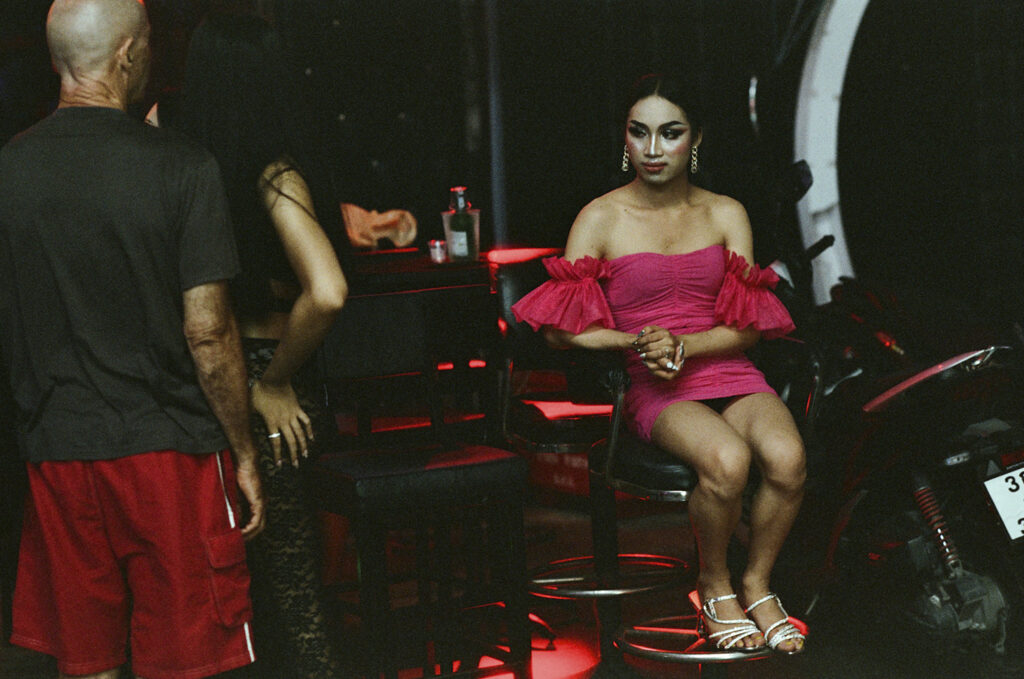
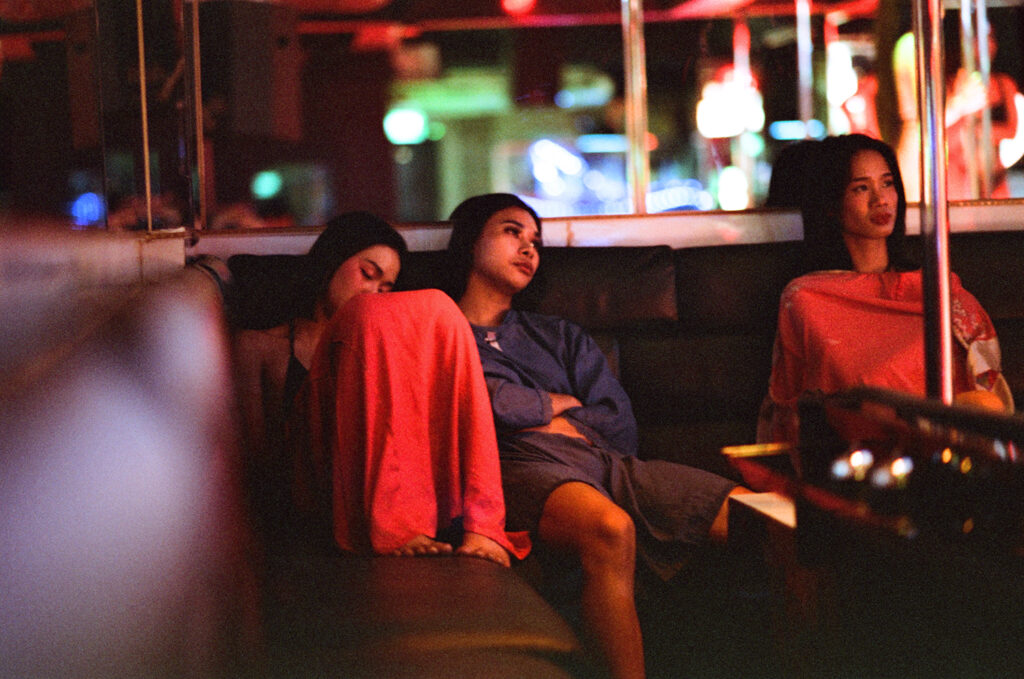
From left to right: Between Shifts at a Walking Street Bar, Pattaya City, Thailand, 2024. / Wearing Bunny Ears at Work, Pattaya City, Thailand, 2024. / Waiting Outside a Go-Go Bar, Pattaya City, Thailand, 2024. /
Sleeping Between Stage Sets at a Walking Street Bar, Pattaya City, Thailand, 2024.
MONEYGAME Thailand, by Elizabeth Waterman
The photographs featured here are drawn from MONEYGAME Thailand, a forthcoming photographic book exploring identity, performance, labour, community, and belonging through the lives of people whose lives intersect with Thailand’s nightlife industry. This selection focuses on trans women whom I have returned to photograph on multiple trips, building relationships as trust and familiarity deepened. Working almost exclusively on analogue film, the photographs move between public performance and private moments, revealing the rhythms of everyday life that exist alongside the stage.
Rather than documenting spectacle, the work considers how identity is expressed, inhabited, and performed. Through moments of friendship, work, ritual, tenderness, and solitude, the photographs invite viewers to encounter lives that resist simplification and extend far beyond the roles through which they are often understood.