I’m just a vessel. Dimes Square and the horrible shell of wisdom
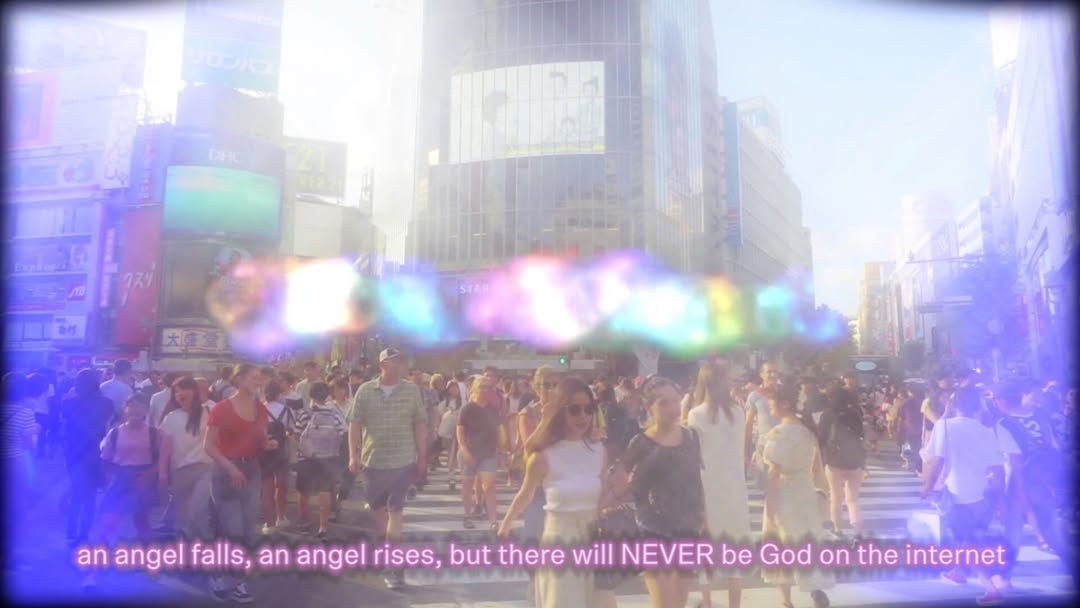
Dimes Square resists definition, operating as a feedback loop of images, discourse and affect. Through Honor Levy’s account, in dialogue with Nell Whittaker, it emerges as a collective rehearsal where irony hardens into structure and the internet becomes lived form, raising questions of authorship, innocence and the desire to exist as a vessel within history.
During my conversation with Honor Levy for Hyperlocal at the Triennale Milano, I asked her about “Z is for Zoomer”, one of the stories in her 2024 collection My First Book. The story is a lexicon of “words of interest”, from autism to ketamine, or “some words that have defined us and some words we have defined”. Levy, forced to consider the story in public, said that her feelings about it would be best expressed in a portmanteau between “yawn” and “vomit”. “It’s the one thing I really, really cringe at,” she said, “Something that’s so boring, but also so disgusting.” She pointed out that her reaction mirrors a generalised response to Dimes Square, the microneighborhood we were called upon to discuss—a cultural phenomenon people have liked to describe similarly as something both vapid and evil, as exhausting as it is stupid, “vawn”, perhaps, or “yomit”.
In Levy’s telling, Dimes Square was something constituted only by external forces, formed of projections and fantasies, misreadings and deliberate misleadings, hangers-on and whackjobs, “a photocopy of a photocopy”—a hypersition, in which lies and assumptions became truthful through an LLM-like retelling and rehearsal. It wasn’t so much an invention as a reaction, to the sentimentality of 2000s cultural liberalism and the sincerity of the 2020 Bernie campaign. It started as a “vibe shift”, a cosmic transmission that happened, according to Levy, between July 3 and July 7, 2022 when there was a reverberation through the universe, “something mystical, magical, like group psychosis, in the air.” This was, in Levy’s estimation, “the internet becoming physical”.
Tommaso Dell’Anna, in this magazine, compared Dimes Square to the Futurists, as two rare movements made up of an intellectual avant-garde aligned to non-progressive causes. While the thrusting, violent fantasies of the Futurists exist on a separate aesthetic plane to Dimes Square and its uncertain Klonopin haze, the void is the same, as is the yearning for a kind of purity that is miles away from the pervasive “it’s okay to be messy” liberal apologism. As the Manifesto put it, “Let’s break out of the horrible shell of wisdom and throw ourselves like pride-ripened fruit into the wide, contorted mouth of the wind! Let’s give ourselves utterly to the Unknown, not in desperation but only to replenish the deep wells of the Absurd!” If this is a classically fascistic attachment to modernity as rupture, it’s one that shares its DNA with contemporary desire to escape the stale prohibitions of the elders, and to turn instead to the random vacuity of the meme.
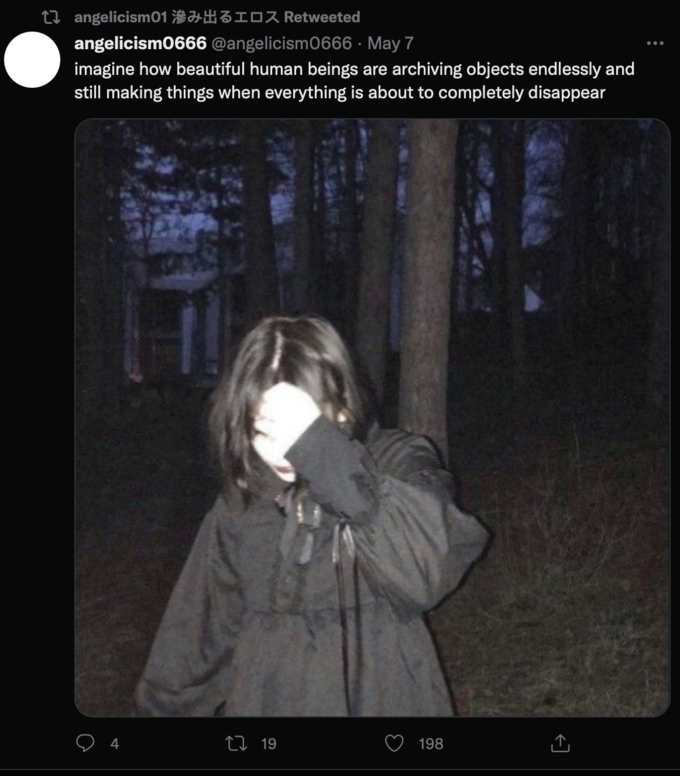
Sometimes it seemed like the whole scene was an exercise in disclaiming individual significance, in reaction to a politics which demands we recognise ourselves as complicit in a cybernetic system that exists to funnel subscription money to AI military research. “Nothing to do with me!” has been the Dimes Square refrain, but it’s not always convincing. Levy, in her writing, often comes across as much more agonised by the way in which the world is organised. A Reddit comment about My First Book reads, “She seems like a lost little girl in a way that I feel like I am a lost little girl in the big corporate internet connected globalized world.” When I asked her about innocence, she said,
“The great Swedish rapper Bladee has this great tweet, ‘Chill bro, like I didn’t mean to piss you off, I’m just a vessel.’ In downtown New York, people have gotten mad at me or said that I’m like alt-right or like fascist and stuff. I was like, no, I was just a vessel. But isn’t that what being a political person is, a vessel for some great movement of history to move through? […] Is innocence, in a sense, like, I don’t know, like kenosis, being drained, [in] the Biblical [sense of] being totally empty? And then, like ketosis, your body burning its own fat?”
Kenosis is the word used in Paul’s letter to the Philippians to refer to Christ’s emptying himself of divinity to take carnal form; ketosis is the looksmaxxing contemporary equivalent. Levy’s book similarly resounds with purification rituals to deal with the problem of autonomy, as well as self-regard and self-abnegation. It contains many mentions of mirrors, and twice to the mirrors of Versailles. It contains 32 appearances of the word “sorry”.

How much innocence can be maintained through passivity?
How much innocence can be maintained through passivity? For the Futurists, innocence represented the unification of thought, word and deed into a philosophical machinery. For Levy, it’s more of a Homer-stepping-back-into-the-hedge scenario. In the paperback edition of My First Book, there’s a story called “The Stenographer”, which opens with an epigraph from Irmgard Furchner, a secretary and stenographer at Stutthof concentration camp, who aged 96 was charged with 11,412 counts of accessory to murder and 18 additional counts of accessory to attempted murder. Levy’s protagonist is an old lady in a rustling wood, in communion with “purpose, work and freedom”—words with an obvious dark echo—and the writing is vague and pleasurable (the stenographer remembers “a marriage, a long, steady employment […] a garden full of carrots”). In a way, this woman is perhaps the book’s most emblematic figure, and the whole project’s. She is in possession of monumental guilt, but she has been abstracted from it by bureaucratic process, collectivity and time. She was eighteen when she worked in the camp, so now as an old woman she is tried as a minor, a strange eternal girlhood. She comes to the woods “seeking nothing”, “full up of empty”, and she finds it. The guilt is so enormous it becomes the world, which in the end, absorbs her into it. This is an act of love, Levy writes, which is the same thing as rotting: “the earth loves so it can turn the foul to hallow.” It’s also an act of faith.




Eulogising Dimes Square, one feels like the worshipper of the past described scornfully in the Futurist Manifesto, engaging in an activity “from which you emerge fatally exhausted, shrunken, beaten down”. Last year, H&M made a Dimes Square T-shirt, and the recent round of Dimes Square discourse on Madeline Cash’s Lost Lambs felt cursory. Everyone’s using slurs again, and talking about bone smashing. The vibration is stilled. The frisson of speaking like someone on 4chan in the public sphere is diluted when White House staffers release Truth Social posts bragging about “lethalitymaxxing” in Iran.
The stenographer sees, in the thin black tree branches against the sky, the shorthand she used to produce the records of all those people sent to the camps. Levy, in our conversation, worries about the way her speech itself would later be scraped up by some LLM and converted into fact. Neither writing nor speaking is a project of the innocent, as much as one wants to will themselves into vesselhood, but being a conduit isn’t as good as free invention. Levy asks, “Isn’t that what being a political person is, a vessel for some great movement of history to move through?” It’s true insofar that everyone is a political subject regardless of what they do, but it’s political agency that sustains the imaginary that, ultimately, any avant-garde relies on. “I used to want to make up a lie to make it true,” says Levy towards the end of our conversation. “But now I can’t even think about like a lie that I want to become real.”